
Understand this result with chimp test. Keep the task and input settings visible when comparing results.
How does the verbal memory test work?
The verbal memory test asks for one decision about each displayed word. Choose New on its first appearance in this session and Seen when it returns later. A correct decision adds one point; a wrong decision adds one error. Three errors end the game.
The first word is always new. After that, when both pools are available, each item has an equal chance of coming from previously displayed words or the unseen pool. The game records correct decisions rather than a diagnostic or population score.
- Start a fresh session.
- Read each word before responding.
- Use the buttons, or use S for Seen and N for New.
- Keep the same response method throughout the session.
The verbal memory test checks the history before the current word. Your decision cannot rewrite whether it was previously displayed. An incorrect answer therefore does not change the reference set used for the next item.
What counts as Seen in the verbal memory test?
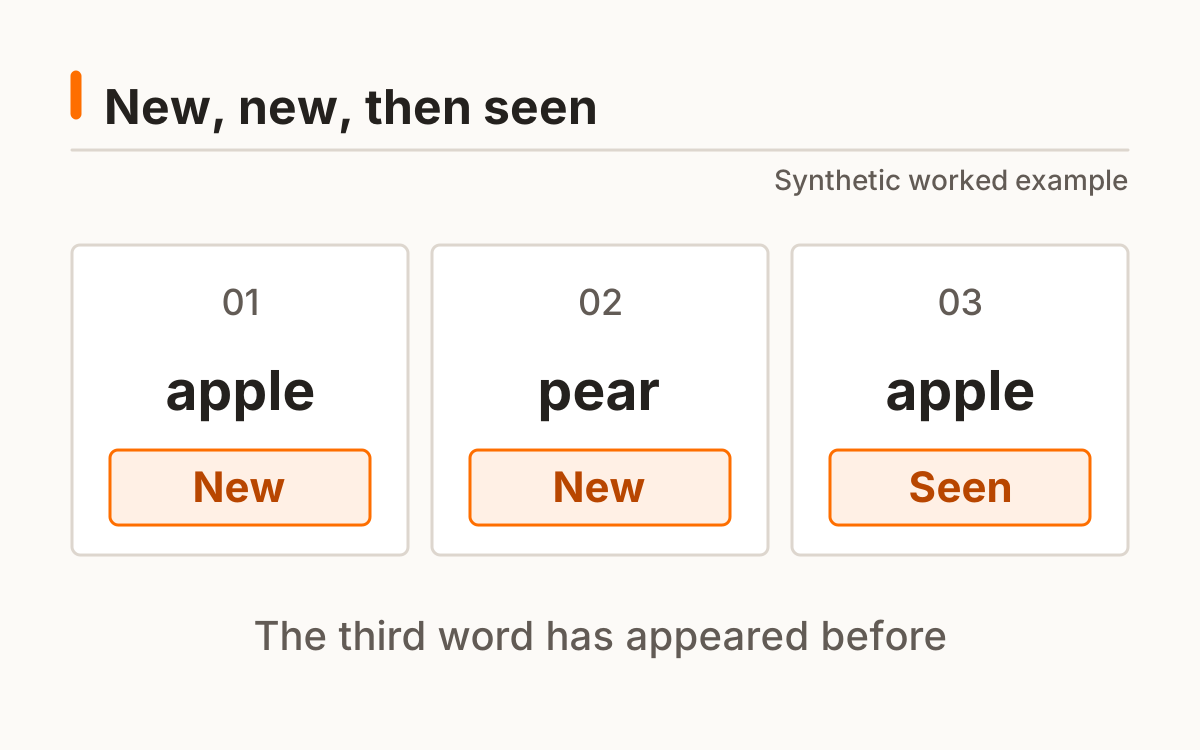
Seen means the exact word appeared earlier in the current session. A word being familiar in everyday life does not make it Seen here. For a synthetic sequence, apple → New, pear → New, apple → Seen gives three correct decisions. Reset clears the session’s seen set.
Verbal memory: which skill does this game use?
This verbal memory game uses recognition of earlier items in a stream. You are deciding whether the current item belongs to the session history; you are not being asked to type every word in order or explain its meaning. The score depends on these specific rules.
Vocabulary, attention, input familiarity, and prior experience with the pool can affect a session. That does not make a short game a clinical measure of verbal ability. The verbal memory test does not compare you against a representative dataset or infer a medical condition.
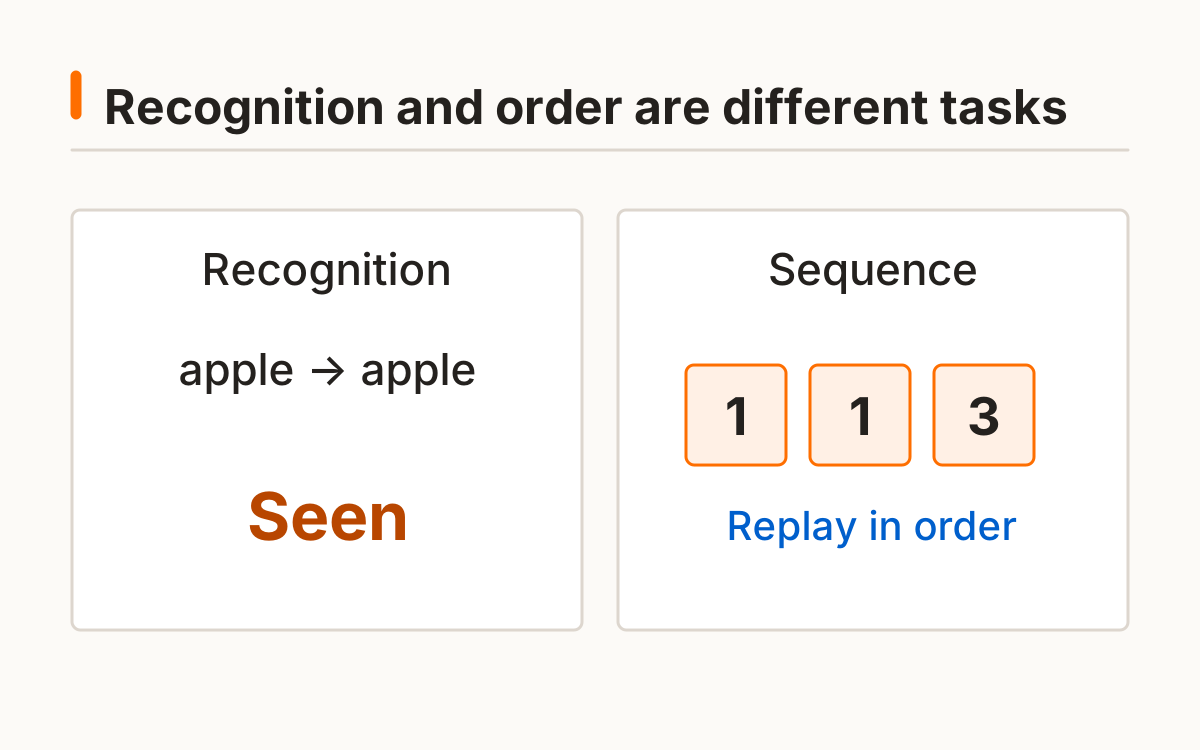
Recognizing a repeated word and recalling an ordered pattern are distinct demands. A score here does not predict a particular grid or sequence level. Keep the points attached to the recognition rule rather than treating all memory-game scores as one scale.
How are memory test words selected?
The memory test words come from an original selection of 250 common English words shipped with the site. It is an ordinary game pool, rather than a proprietary or standardized psychometric list. Unseen words are drawn without replacement, so a newly drawn item cannot already be in the displayed set.
Previously seen words are selected from the current session only. Once the unseen pool is exhausted, the session ends with a completion message instead of searching indefinitely for a new word. The displayed word is added to session history before the next item is chosen.
A word can return several times because displayed items remain eligible for the seen pool. A new item is removed from the unseen pool when drawn. The rule balances decision types without falsely labeling an earlier displayed word as new.
How should you repeat a session?
Start from an empty seen set each time you repeat the verbal memory test. A reset begins a genuinely new session history, although your own familiarity with the game and pool remains. Keep the input method consistent, and take a break if your decisions become rushed.
Optional local history saves completed scores with the stated protocol. It does not upload word choices or build a profile. Use the sequence or numbered-grid game for a different task, and avoid interpreting the different point systems as a common memory scale.
Use either the buttons or S/N keys consistently. The verbal memory test records the method and asks you to continue with it for that session. To switch methods, start fresh and retain the score as a separate observation.
Frequently asked questions
Does Seen refer to my whole browsing history?
No; only words presented in the current session.
Are there medical norms?
No clinical interpretation is supplied.
Can I play with a keyboard?
Yes; use S for Seen and N for New.
Why can repeated sessions get easier?
Familiarity with this game and word pool can affect performance.
Are the words copied from a clinical test?
The game uses an original pool of ordinary English words.
Sources and method
This is an original game with explicit v1.0 rules, rather than a reproduction of a clinical or research test. No empirical norm or external dataset is used.
Published October 20, 2026 · human-reactiontimetest.com · Report a correction