
Try the method in reaction time. Keep the task and input settings visible when comparing results.
What does a reaction time test in psychology operationalize?
A reaction time test in psychology defines an outcome through a specified task and interval. Researchers establish cues, responses, trial structure, validity rules, and analysis. Changing them can change what a number describes even when it remains in milliseconds. Keep the operational definition attached to the result.
Read the method before the headline number. Ask which participants were tested, what they were instructed to do, and which equipment observed the endpoints. The general task label does not establish interchangeability. This guide explains how to read those details without assigning a psychological trait from a browser score.
- Identify task and mapping.
- Read validity rules.
- Check participants and apparatus.
- Keep statistics with the method.
Can a reaction time test in psychology diagnose someone from one score?
A game score cannot diagnose a condition. Clinical or research interpretation requires an appropriate method and validation for the intended use. This website does not perform that assessment.
The original paper describes its own simple-response task and equipment calibration. Its measurements are not norms for this browser protocol. Woods and colleagues: Factors influencing the latency of simple reaction time (2015).
Simple reaction time test: how does it differ from choice and inhibition?
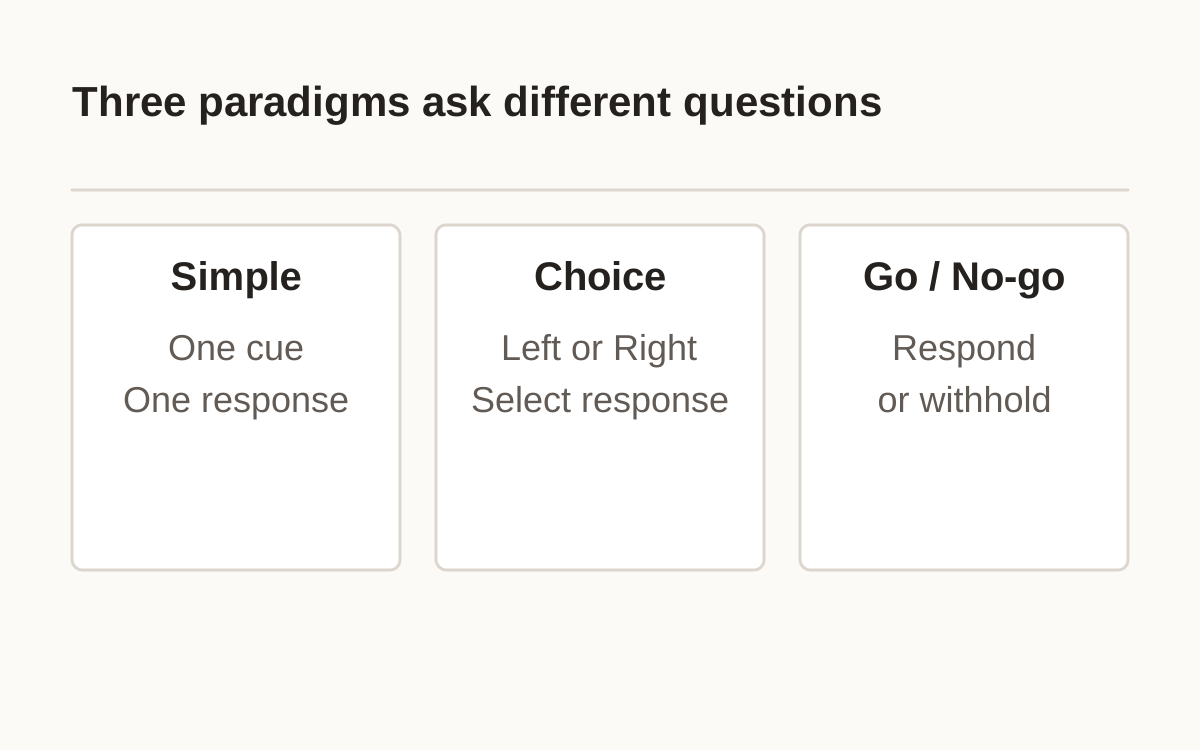
Simple response asks for one action to a signal. Choice requires selecting a mapped action. GO/NO-GO sometimes requires withholding it. Correct withholding has no response latency; inserting zero into a timing summary changes the meaning of the result.
The site offers original recreational examples with explicit rules, not a standardized diagnostic battery. Differences between medians cannot simply be subtracted and labeled as an isolated processing stage. Stimulus design, response requirements, and error handling differ too. State the observed task rather than assuming a number represents a general mental capacity.
| Paradigm | Required action |
|---|---|
| Simple | Respond to the cue |
| Choice | Select the mapped response |
| GO/NO-GO | Respond or withhold |
Deary Liewald reaction time test: why does the named method matter?
The Deary-Liewald task is a named program and procedure described by Deary, Liewald, and Nissan. Their cited paper concerns simple and four-choice tasks. A browser game with two buttons does not reproduce that program simply because both involve choosing responses.
Read the original publication for what was administered and how evidence was obtained. This site does not distribute the program or import its validation and norms into its two-choice task. If a named instrument is required, preserve its version, instructions, scoring, and intended use instead of substituting a similar interface.
The original paper identifies a particular program and procedure. This site does not reproduce it or import its validation into an original browser game. Deary, Liewald and Nissan: A free, easy-to-use, computer-based simple and four-choice reaction time programme (2011).
How should you read errors, samples, and reported findings?
Errors and exclusions shape interpretation. A correct-response median from a few retained trials has a different denominator from a summary of every presentation. Check how early responses, wrong choices, omissions, and interruptions were handled. Then examine uncertainty and procedural detail rather than treating one point estimate as the whole finding.
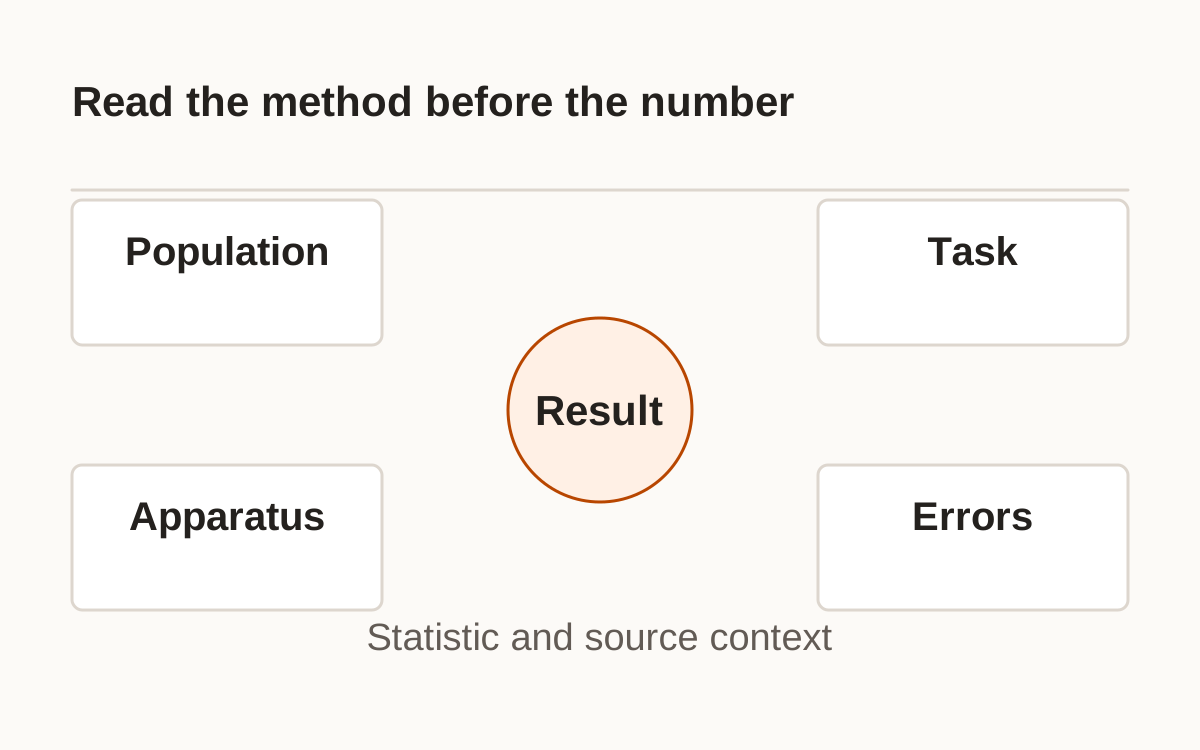
A sample describes studied people and conditions, not automatically every reader. Equipment calibration belongs with that study’s timing claims. Woods and colleagues provide original simple-response research context; the site’s protocol describes only its own implementation. A casual result here supports no diagnosis, intelligence estimate, or personal health conclusion.
Frequently asked questions
Is a browser game automatically a validated research test?
No. A familiar format does not establish equivalence to a named instrument.
Do different paradigms share one norm?
Their tasks and methods differ, so preserve source-specific context.
Does a response window define biological possibility?
It is an acceptance rule in a procedure, not a universal biological threshold.
Can this site diagnose ADHD or concussion?
No. It supplies no clinical assessment for those conditions.
Why are participant and equipment details needed?
They determine what the reported measurements describe and which comparisons are supported.
Sources and method
- Woods and colleagues: Factors influencing the latency of simple reaction time (2015) · checked 2026-10-21. Read within its original procedure; this site’s examples and rules are separate.
- Deary, Liewald and Nissan: A free, easy-to-use, computer-based simple and four-choice reaction time programme (2011) · checked 2026-10-21. Read within its original procedure; this site’s examples and rules are separate.
Published October 21, 2026 · human-reactiontimetest.com · Report a correction