
Understand this result with reaction time test. Keep the task and input settings visible when comparing results.
How does this reaction time game score a decision?
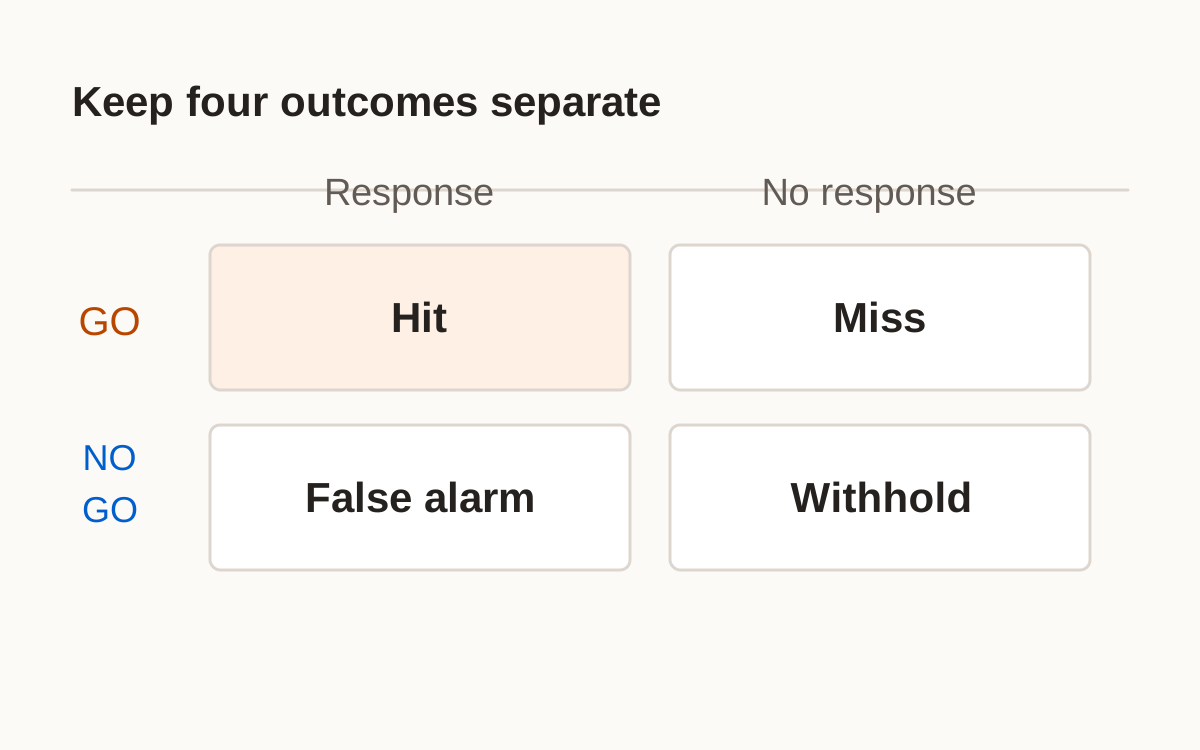
This reaction time game scores whether a response matches the cue. A session shuffles fourteen GO and six NO-GO cues. Each has a 1.2-second response window. A GO response inside the window is a hit; failing to respond is a miss. A NO-GO response is a false alarm; withholding through its window is correct.
The median uses only GO-hit times. A correct withhold has no latency and never enters the list as zero. If there are no GO hits, the median remains unavailable. This is an original recreational task with explicit rules, without a clinical interpretation of attention or impulse control.
- Choose one input.
- Start and wait for the cue.
- Respond only to the GO circle.
- Read the result and manually advance.
What happens after an early press in the reaction time game?
An early press increments its own counter and retries the same cue without consuming a scored presentation. Wait for the instruction to change instead of predicting the delay.
This documentation defines the monotonic software clock used for intervals; it does not calibrate physical display or input delay. MDN: Performance.now().
Reaction game: which cue asks you to respond?
GO uses a circle and the word GO. NO-GO uses a square and the words NO-GO, so color is not the only instruction. The wait lasts a random 0.8–2.2 seconds before the cue is scheduled in an animation frame. Keyboard mode requires a fresh Space press; holding it does not produce extra responses.
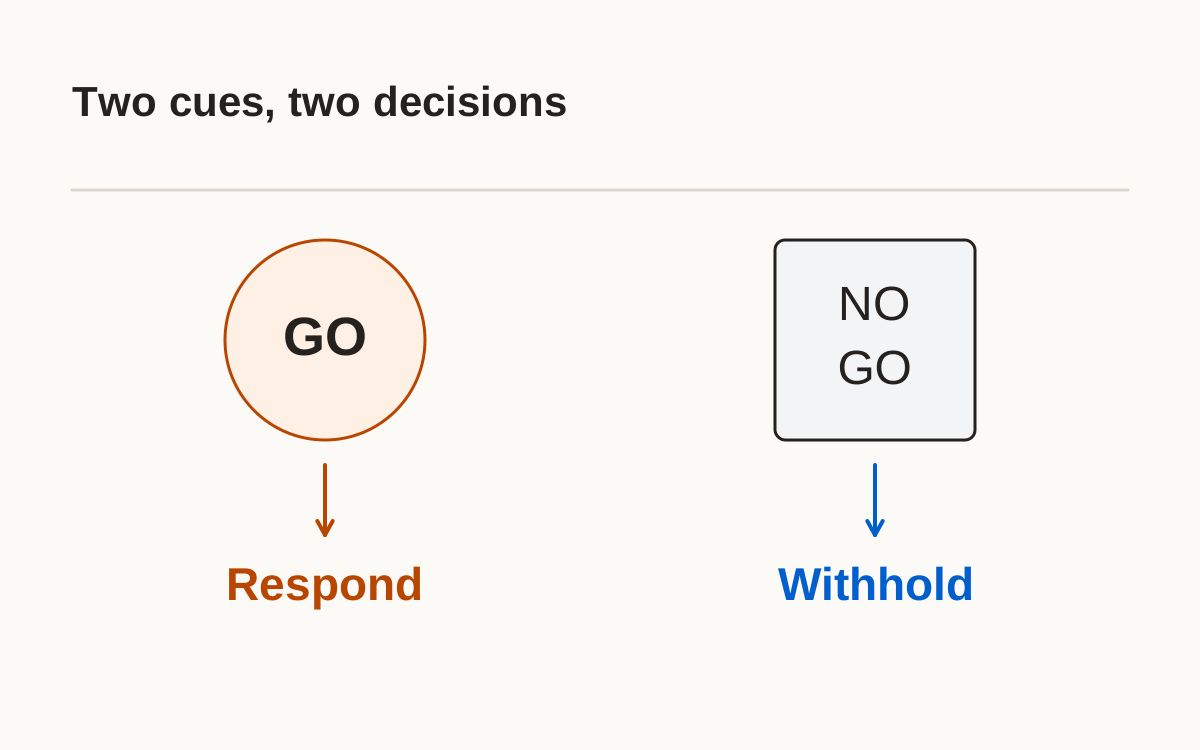
Mouse and touch modes accept the selected primary pointer type. Keyboard mode does not accept a pointer answer. The software interval starts when the cue is updated in the animation callback and ends at the accepted input handler. Physical display, switch, and device delays remain uncalibrated.
Reaction test game: how do false alarms and misses differ?
False alarms and misses describe different decisions. Pressing on NO-GO supplies an action that should have been withheld; missing GO omits a required action. Combining them into a speed number hides that distinction. The result lists every cue and outcome, so a fast median cannot conceal an error-heavy session.
A synthetic perfect session has fourteen GO hits and six correct withholds. With no GO hits there is no timed median, even if some withholds are correct. This example checks scoring logic, not a performance norm. A response at or after the window’s end falls outside its acceptance interval.
| Cue | Response | No response |
|---|---|---|
| GO | Timed hit | Miss |
| NO-GO | False alarm | Correct withhold, no time |
How should you repeat a session without changing the rules?
Keep the protocol and input consistent when repeating sessions. Focus loss or a hidden page cancels the active round without consuming its cue. Return and retry when ready. Reset cancels pending callbacks and clears the current attempt.
History starts off. Enabling it retains completed records in this browser; the CSV includes cue-level records and settings. Review outcomes alongside times instead of keeping only a fastest press. A change here describes this game on this setup; it does not establish a sporting, driving, or medical ability.
Frequently asked questions
Does NO-GO mean a slow response?
No. Correctly withholding a response has no latency value.
Are the cues always in the same order?
No. Fourteen GO and six NO-GO cues are shuffled for each session.
Can I use Space?
Yes. Choose keyboard mode and use a fresh Space press for GO.
Is this an ADHD or impulse-control diagnosis?
No. It is an original recreational browser task without diagnostic interpretation.
Does an early press count as a completed cue?
No. It is recorded separately and that round is retried.
Sources and method
- MDN: Performance.now() · checked 2026-10-21. Read within its original procedure; this site’s examples and rules are separate.
Published October 21, 2026 · human-reactiontimetest.com · Report a correction