
Understand this result with chimp test. Keep the task and input settings visible when comparing results.
How does this memory grid define a completed pattern?
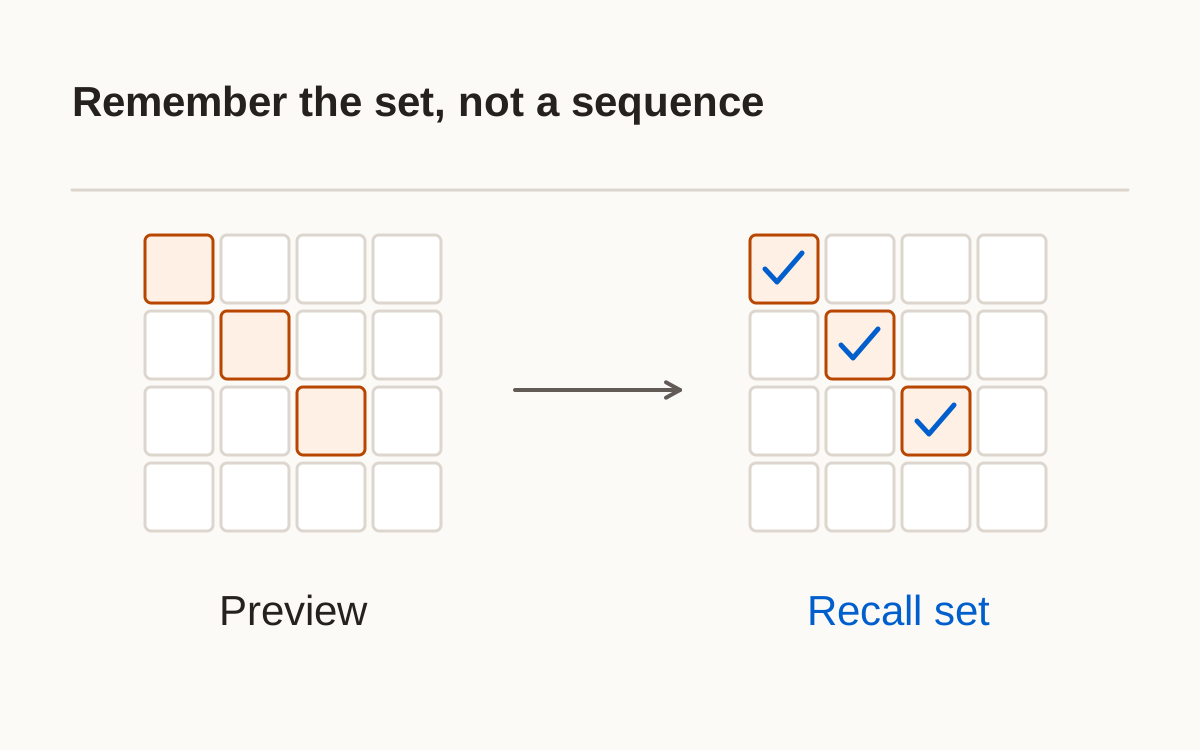
The memory grid previews a set for 1.2 seconds, hides it, and asks for the same positions. Its sixteen cells form four rows and four columns. The first set has three unique positions. Each completed set advances the size by one up to twelve. Your score is the highest size actually completed.
Selections can be toggled off before checking. Check is available only at the required count. A wrong submitted set adds one failure and offers a fresh pattern at the same size. Three failed sets end a session. An interrupted round does not count as a failed memory response.
- Study during the preview.
- Wait for all highlights to disappear.
- Select the required number of positions.
- Review and choose Check.
What if you select an extra cell in the memory grid?
Exactly matching the position set matters; selection order does not. The right number of cells is necessary but insufficient. Every selected cell must belong to the previewed set.
Visual memory test: does selection order matter?
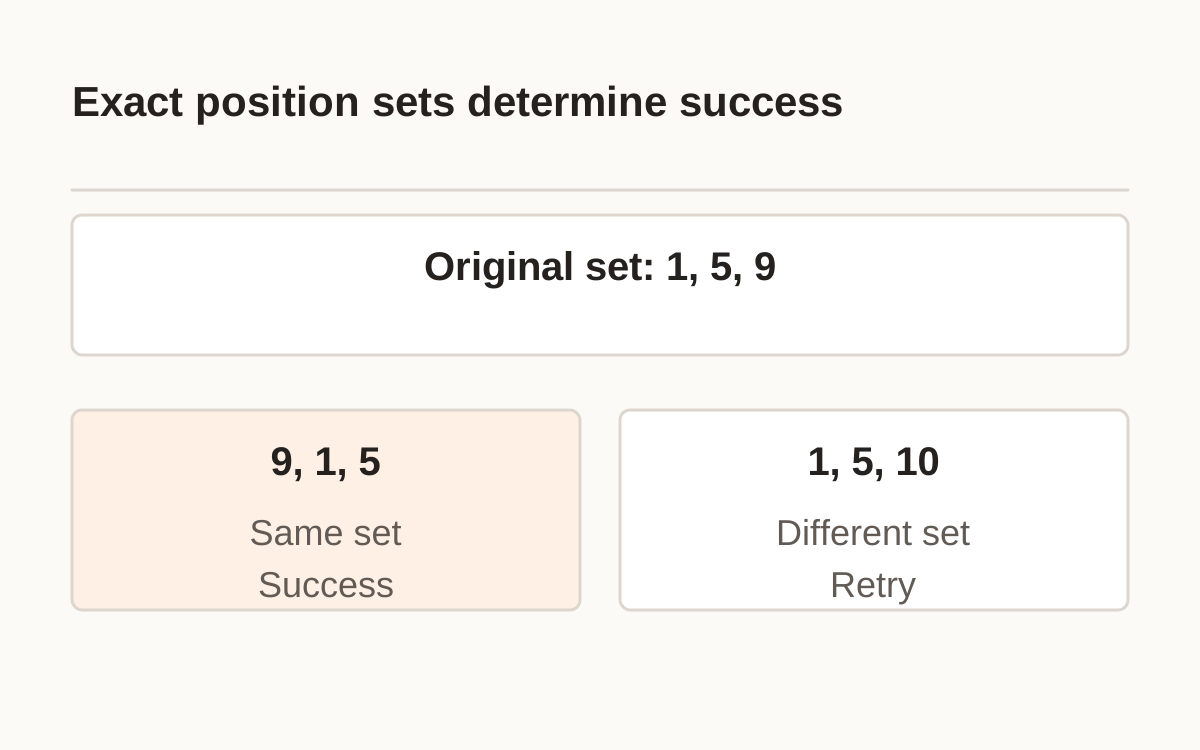
This task uses set recall rather than sequence reproduction. A synthetic target of positions 1, 5, and 9 is matched by selecting 9, 1, and 5. Selecting 1, 5, and 10 fails despite having the same count. Toggling a cell does not create duplicate positions.
Mouse and touch modes accept the selected pointer type. With keyboard input, arrows move focus and Space or Enter toggles a cell. Tab to Check after selecting the required count. During recall, accessible labels identify row and column only; the hidden answer is not left in those labels. Preview cells are unavailable for selection.
Grid memory game: what changes after a success or failure?
Completed size and failed attempt are separate outcomes. Completing five positions and failing at six leaves the best at five. A shown level is not automatically credited. After a failed submission, a new random set prevents the retry from becoming another attempt at an already-revealed answer.
There is no speed bonus. Recall remains available until submission, reset, or interruption. That separates this task from timed selection games. Completing twelve finishes at the stated cap; it does not imply perfect memory outside the game. Three failures end the session even if the last attempt contained some correct positions.
| Event | Effect |
|---|---|
| Exact set | Advance and update best |
| Wrong set | Failure; fresh set at same size |
| Focus loss | Cancel round without failure |
| Complete twelve | Finish at cap |
How can you compare sessions using the same preview rules?
Keep preview duration, grid dimensions, input, and rules consistent. This game provides no clinical scale or population percentile. Sequence-memory and chimp-style tasks use different information and responses, so keep their results in separate categories.
Focus loss clears the preview and selections and offers a fresh pattern at the same size. Reset clears the session. Optional browser history retains completed results and export includes set-level outcomes. The highest completed size describes these particular rules; it cannot establish intelligence, health status, or general memory capacity. Review the whole session rather than treating a single fortunate attempt as a norm.
Frequently asked questions
Is order important here?
No. The selected set must match the displayed set, regardless of selection order.
How long is the preview?
The original protocol uses a 1.2-second preview before hiding the pattern.
Can I change a selection before checking?
Yes. Select a cell again to remove it, then check exactly the requested number.
What is the score?
The largest completely recalled pattern, from three to twelve cells.
Does it estimate IQ or diagnose memory?
No. It reports only this original game’s completed pattern size.
Sources and method
This is an original game with explicit v1.0 rules, rather than a reproduction of a clinical or research test. No empirical norm or external dataset is used.
Published October 21, 2026 · human-reactiontimetest.com · Report a correction