Try the method in reaction time test. Keep the task and input settings visible when comparing results.
How to improve reaction time: where should you start?
How to improve reaction time begins with a fair baseline. Choose one task and keep its response definition fixed. Collect several valid trials, retain the raw values, and note the input and device before changing a practice routine.
A repeatable routine helps you answer a limited personal question about that task. It does not prove a general neurological change. Becoming familiar with a cue, control, or word pool can affect performance without transferring to unrelated activities.
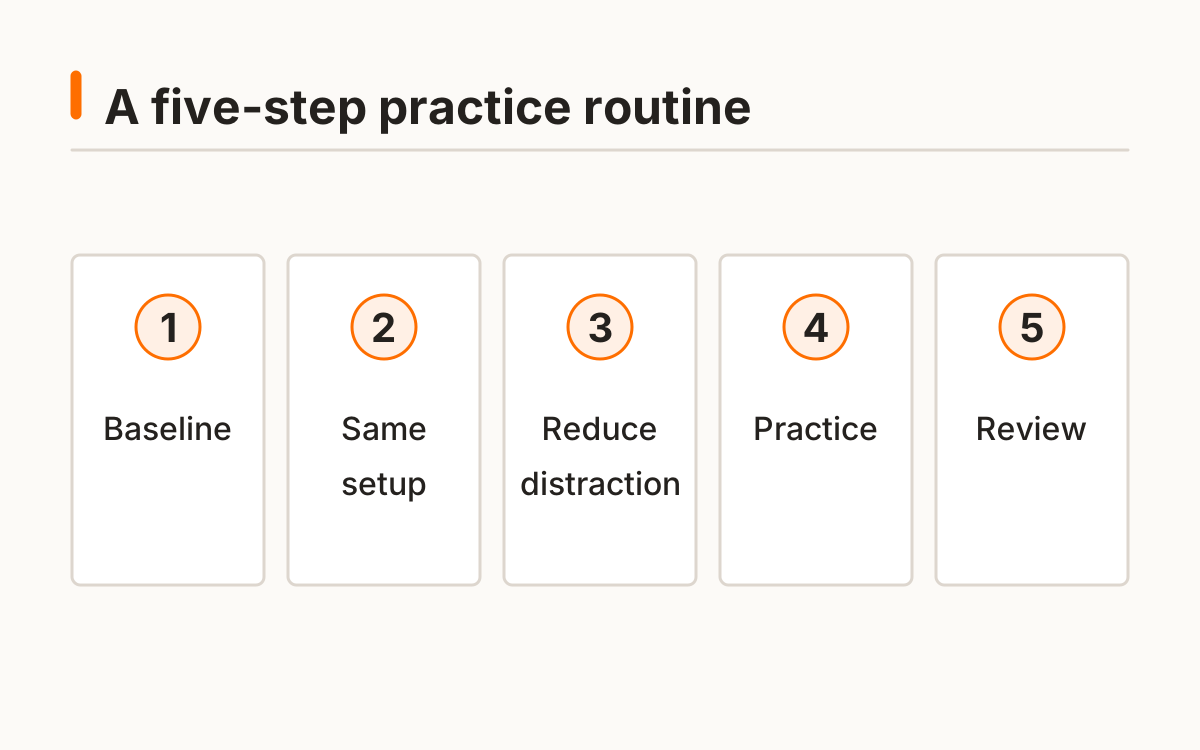
- Set a baseline with a short valid series.
- Fix the protocol, input, and device.
- Reduce avoidable interruptions.
- Practice a short block, then rest.
- Review multiple comparable sessions.
Choose an observable question, such as stability across matching sessions. How to improve reaction time is too broad an inference if every trial changes the cue, device, and scoring. A bounded task gives the log a clear meaning.
How to improve reaction time: what should you log?
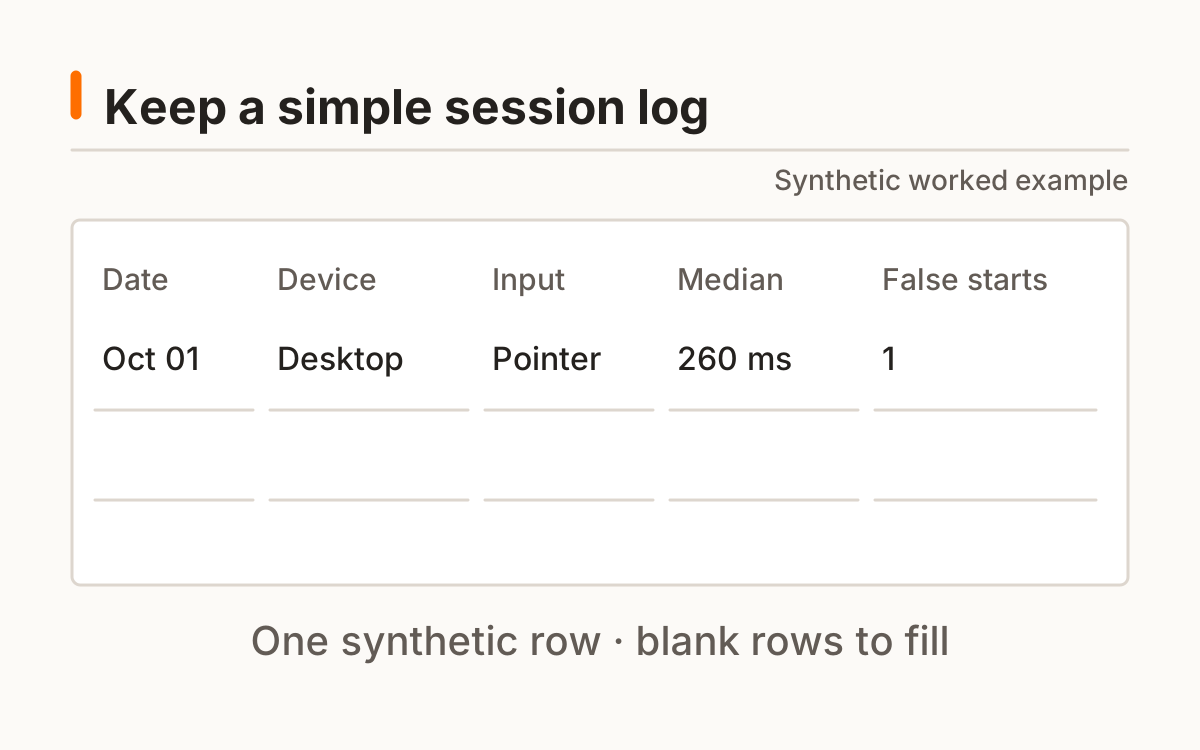
Log the date, task, protocol version, device, input, valid-trial count, median, spread, and false starts. Add a short note when the conditions change. Keeping these fields makes it possible to compare like with like; a bare best score cannot explain whether a different task or device created the change.
How to train reaction time without changing the test?
To train reaction time without changing the test, preserve the waiting range, cue, input, and scoring rules. Use the same number of valid trials when comparing blocks. Changing several variables at once may produce a different score, but it makes the reason harder to interpret.
Compare medians and spread across sessions rather than selecting a single new best. Keep false starts visible: guessing earlier is not the same as consistently responding sooner after a signal. A training log should make that difference easy to spot.
Preserve the comparison task while trying a separate routine. If the benchmark changes, before-and-after scores describe different procedures. Even with a stable benchmark, an observed difference alone cannot identify what caused it.
Exercises for reaction time: what can practice establish?
Exercises for reaction time can establish familiarity and observed performance on the practiced task. They do not automatically establish gains in sport, driving, or everyday safety. Those wider outcomes would need their own well-designed evidence and appropriate measures.
The cited sleep study examines sleep deprivation and vigilant attention under an experimental task. It does not test this website’s drills or establish their efficacy. Avoid using sleep loss as a training challenge; pause a session when tired instead of interpreting fatigue as a useful difficulty setting.
Note familiarity with the controls and word pool. Understanding a game and recognizing its material can affect repeated play. Those observations are useful but narrower than demonstrated improvement across unrelated activities.
This experimental sleep study concerns vigilant attention under its own procedure. It does not test this website’s practice exercises. Sleep deprivation and vigilant attention (2018).
Which improvement claims need stronger evidence?
Claims about broad improvement need evidence that measures the claimed outcome. A lower browser median is not a controlled experiment showing that the tool caused a real-world benefit. Repeated comparable results are useful personal observations, with their limits intact.
How to improve reaction time should not become a promise of a specific percentage gain, a supplement recommendation, or treatment for a condition. Use the trainer for bounded practice and the basic test for a short baseline. Keep the question, method, and conclusion aligned.
A claim about how to improve reaction time should identify its outcome, comparison, duration, and measure. This site supplies practice records rather than a controlled study of its efficacy. Keep that distinction when reading a changed score.
Frequently asked questions
Will practice help every activity?
Task familiarity does not establish transfer to sport or driving.
Should I use supplements?
This guide does not recommend a substance or dose.
Can sleep loss affect the task?
Research has studied vigilance impairment during sleep deprivation; do not imitate deprivation experiments.
How do I track progress?
Log task, device, input, raw trials and session conditions.
How many days until I improve?
No timetable or guaranteed gain is provided.
Sources and method
Sleep deprivation and vigilant attention (2018). Read this source within its own method; the protocol and synthetic examples on this page describe this site’s implementation.
Published October 20, 2026 · human-reactiontimetest.com · Report a correction