
Try the method in reaction time test. Keep the task and input settings visible when comparing results.
What does mouse response time actually measure?
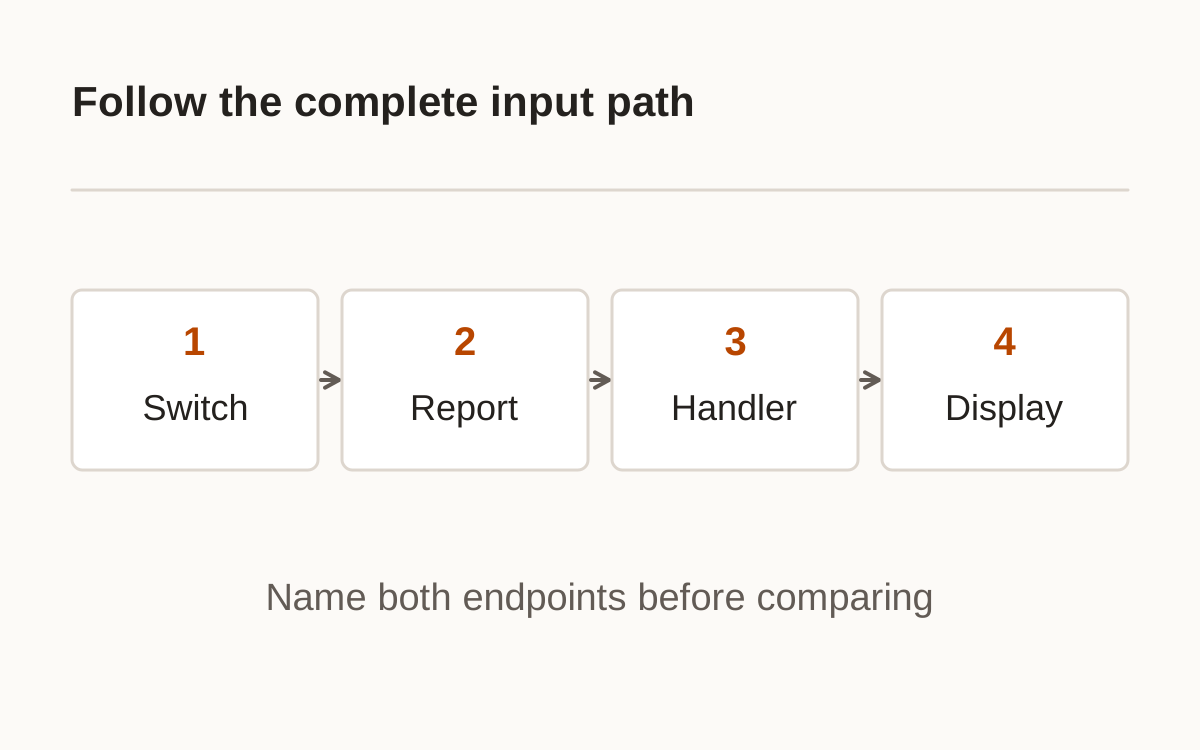
Mouse response time needs named endpoints. Switch activation to a report, input handling to a visible change, and a person seeing a cue to pressing a button are different intervals. A browser reaction task includes human behavior and parts of the equipment path; it does not isolate the mouse.
Write a concrete definition, such as physical switch closure to the corresponding visible change. Then ask how each event is detected. A software timestamp does not independently observe both physical events. The browser can record its own interval without calibrating all stages in the path.
- Name the beginning event.
- Name the ending event.
- Identify directly observed events.
- Keep unmeasured stages visible.
Can a human task isolate mouse response time?
Subtracting two human-task medians does not isolate switch, USB, operating-system, or display delay. Physical latency needs endpoints observed by an appropriate measurement method, not a guessed correction.
This documentation defines the monotonic software clock used for intervals; it does not calibrate physical display or input delay. MDN: Performance.now().
Mouse speed test: is the result movement, clicking, or latency?
A mouse speed test might count clicks, track movement, or time a response. Clicks per second is an event rate. Pointer speed can refer to movement distance or sensitivity. Latency is elapsed time between events. Different units describe different properties.
A click-count tool reports accepted presses within a selected window; a high count does not establish a short switch delay. An aim task includes finding and moving toward a target. Keep sensitivity and target geometry with its result. A keyboard response test also includes human and equipment events rather than independently calibrating a key switch.
How do polling intervals differ from end-to-end delay?
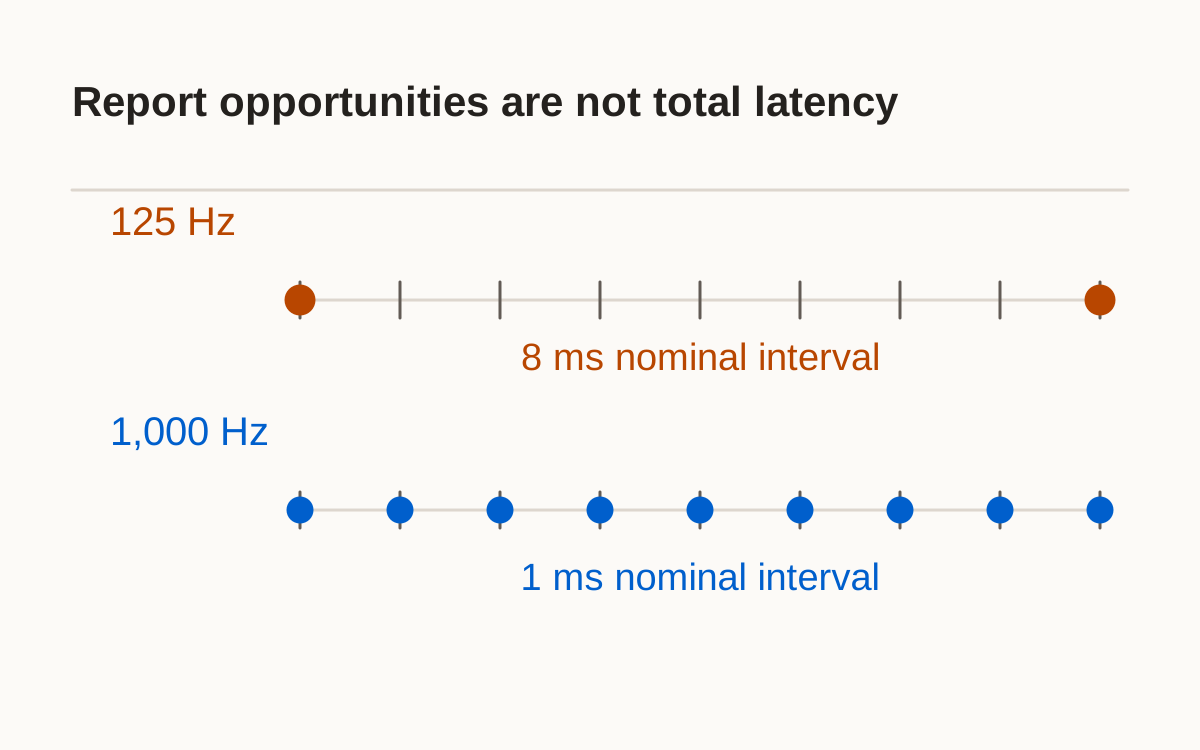
Polling frequency describes report opportunities. For nominal frequency f in hertz, the interval is 1000 ÷ f milliseconds: 8 ms at 125 Hz and 1 ms at 1,000 Hz. These are nominal intervals, not measured click-to-display delays or corrections to a human score.
Microsoft’s USB endpoint documentation identifies polling-interval fields for relevant transfers. A particular device still needs its own interpretation. Switch behavior, firmware, reporting, software, rendering, and display processing can remain in the complete path. Subtracting a nominal interval from a browser median does not create a calibrated human response.
| Frequency | Nominal interval |
|---|---|
| 125 Hz | 8 ms |
| 500 Hz | 2 ms |
| 1,000 Hz | 1 ms |
The endpoint documentation identifies polling intervals for relevant USB transfers. It does not supply an end-to-end latency value for your particular mouse. Microsoft Learn: USB_ENDPOINT_DESCRIPTOR.
How should you record a hardware comparison?
Record the exact device, connection, polling setting, browser, operating system, refresh setting, and protocol. Change one documented setup variable at a time for a personal comparison, retaining raw trials and mistakes. That record can be useful even when physical timing remains uncalibrated.
Several simultaneous changes prevent attributing a difference to one setting. If equipment latency is the question, seek a method with an independently observed reference. This site supplies no device-specific latency ranking or guessed offset for your mouse, and it does not use your reaction as a hardware calibration instrument.
Frequently asked questions
Does 1,000 Hz mean exactly 1 ms click latency?
It corresponds to a 1 ms report interval; the whole latency chain includes other events.
Can this site calibrate my mouse?
No. Its browser tools do not isolate physical switch and display timing.
Is pointer speed the same as latency?
No. Movement scaling and delay describe different properties.
Should I subtract a guessed mouse delay?
Do not apply an assumed correction as though it were a measured calibration.
Does the same issue apply to keyboards?
Keyboard events also have physical and software endpoints that need to be distinguished.
Sources and method
- Microsoft Learn: USB_ENDPOINT_DESCRIPTOR · checked 2026-10-21. Read within its original procedure; this site’s examples and rules are separate.
- MDN: Performance.now() · checked 2026-10-21. Read within its original procedure; this site’s examples and rules are separate.
Published October 21, 2026 · human-reactiontimetest.com · Report a correction