
Try the method in reaction time test. Keep the task and input settings visible when comparing results.
What can a driving reaction time test in a browser show?
A driving reaction time test on a website can illustrate a response interval but cannot establish fitness to drive. This page explains that boundary and distance arithmetic. It supplies no driving simulator, pedal measurement, license assessment, or clearance after fatigue, illness, medication, or substance use.
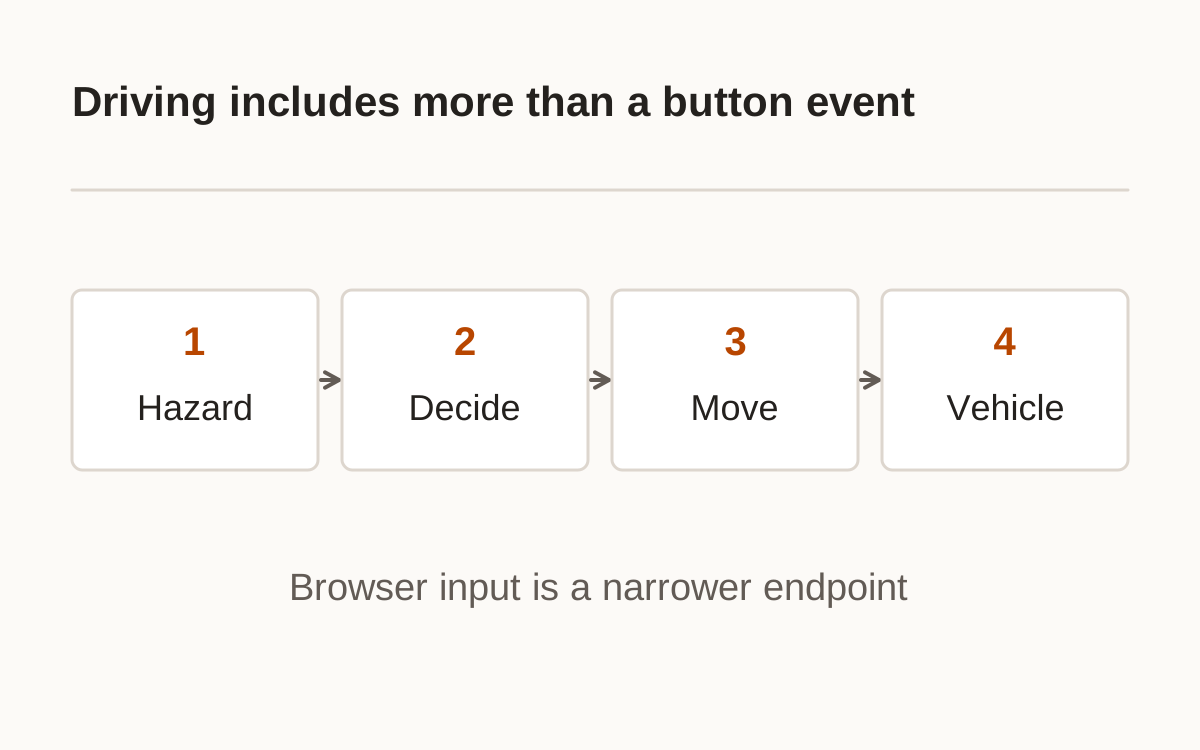
A road event can involve noticing a hazard, deciding, moving to a control, and vehicle response. The endpoint “browser input handler” covers a narrower activity than applying a real brake. Keep those definitions separate. This site’s visual task remains a recreational cue-and-input procedure regardless of how small its result appears.
- Name actual endpoints.
- Separate browser and road tasks.
- State assumptions for arithmetic.
- Avoid a driving determination from a game.
Can a driving reaction time test certify road fitness?
A known screen instruction is simpler than an unexpected road event requiring detection, interpretation, and an appropriate action. This page cannot convert its arithmetic or a browser score into a driving pass or fail.
Driver reaction time test: which real-world stages are missing?
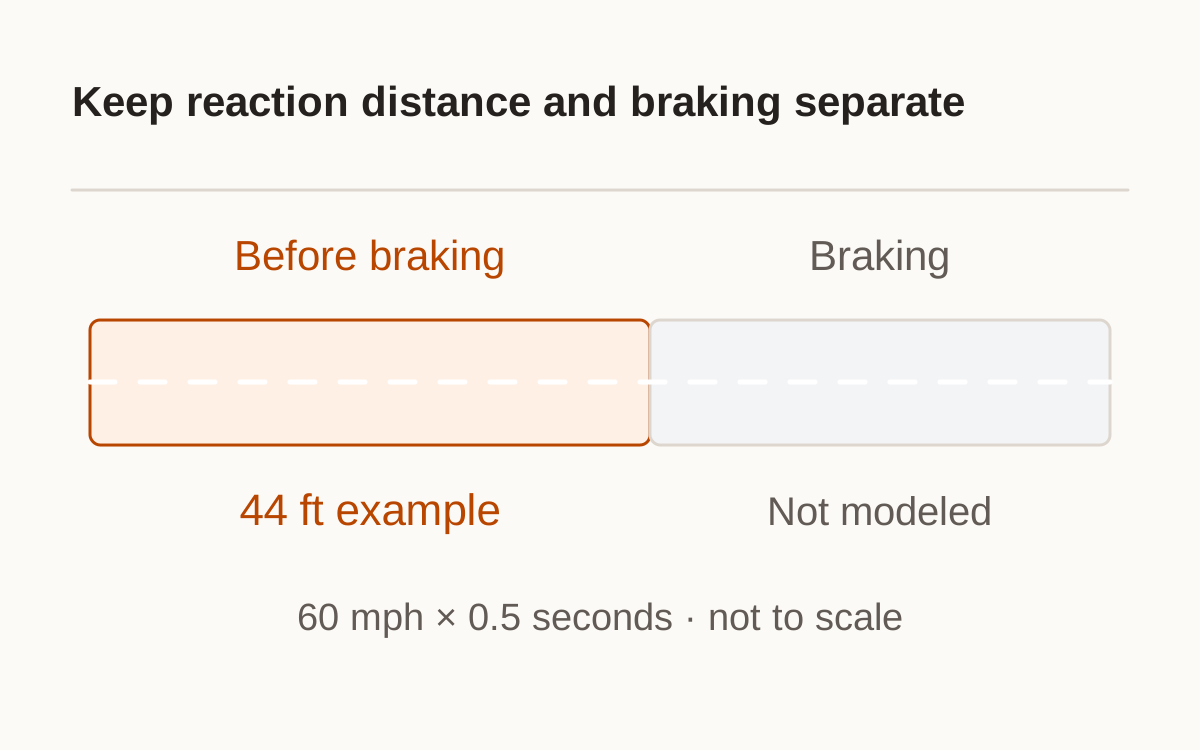
At constant speed, distance during a chosen interval is speed × time. In a synthetic example, 60 mph equals 88 feet per second. Over a hypothetical 0.5 seconds, that gives 44 feet, approximately 13.41 meters. The interval is a teaching input, not a typical driver value or safety margin.
NHTSA’s training material distinguishes perception and response before braking from the subsequent braking phase. This guide uses that conceptual distinction without importing a road norm into a game. Constant speed over the interval is an assumption, and the calculation does not show when a particular person would detect a hazard.
| Synthetic input | Value |
|---|---|
| Speed | 60 mph = 88 ft/s |
| Chosen interval | 0.5 s |
| Distance | 44 ft ≈ 13.41 m |
| Braking | Not modeled |
How does time relate to distance before braking?
Reaction distance and braking distance are separate quantities. Travel before braking is only one component; travel while slowing is another. The first calculation does not produce total stopping distance. This page does not model surface, tires, slope, vehicle condition, braking force, or traffic evolution.
Do not insert your fastest browser response and treat the result as a safe following distance. Detection conditions, movements, and vehicle response have not been shown equivalent. The diagram illustrates components and units, with segments explicitly not to scale. It is not an engineering prediction of a real stop.
The educational manual separates distance during perception/response from braking. Its worksheet is not a validation of this site or a personal fitness model. NHTSA: CORE participant manual, stopping-distance worksheet.
How should you use a browser result without a driving pass mark?
Interpret the browser session only as that task on that setup. Consistency does not assess road judgment or certify fitness. Unexpected events may require different detection and choices from a known instruction, and this site provides no conversion between those tasks.
For an actual fitness concern, use the relevant qualified assessment and official local process. This guide makes no personal medical or legal determination. If studying its arithmetic, retain the hypothetical inputs and explicitly unmodeled braking stage so a reader cannot mistake the example for a complete stopping-distance calculation or a personal driving recommendation.
Frequently asked questions
Does a fast browser score mean I am safe to drive?
No. This site has no validated driving-fitness assessment.
Is reaction distance the complete stopping distance?
No. Vehicle braking and other real-world factors remain separate.
Can this page give a licensing pass mark?
No. It does not reproduce a licensing assessment.
Can a measured browser value be treated as road hazard time?
The tasks and endpoints differ; do not silently substitute one for the other.
Are the distance examples driving advice?
No. They are labeled arithmetic examples, not a recommended following gap or safety limit.
Sources and method
- NHTSA: CORE participant manual, stopping-distance worksheet · checked 2026-10-21. Read within its original procedure; this site’s examples and rules are separate.
Published October 21, 2026 · human-reactiontimetest.com · Report a correction