
Understand this result with reaction time test. Keep the task and input settings visible when comparing results.
How does the chimp test work?
The chimp test is an original numbered-location memory game on a five-by-five grid. Four distinct cells are labeled 1 through 4 at the start. Study them, then select the numbered positions in ascending order after the labels disappear.
Each successful round adds one numbered position to the next level, up to twenty. A wrong selection fails the round, and three failed rounds end the session. Unlimited study is part of this protocol, so a timed version on another site is not the same task.
- Study every numbered position before selecting 1.
- Select the remembered positions in ascending order.
- After success, continue to a new layout at the next level.
- After a failed round, retry that level with a fresh layout.
The chimp test draws new positions each round. Unlimited preparation is allowed, so the task includes self-paced study. Briefly flashing a layout would create a different protocol even if the board and numbered cells looked similar.
When are numbers hidden in this chimp test?
Numbers disappear after you correctly select tile 1. Until then, study time is unlimited. The remaining tiles keep their locations while their labels are hidden. Select those remembered positions in ascending order; the score increases only when the whole level is completed.
Chimpanzee test: what does a level mean?
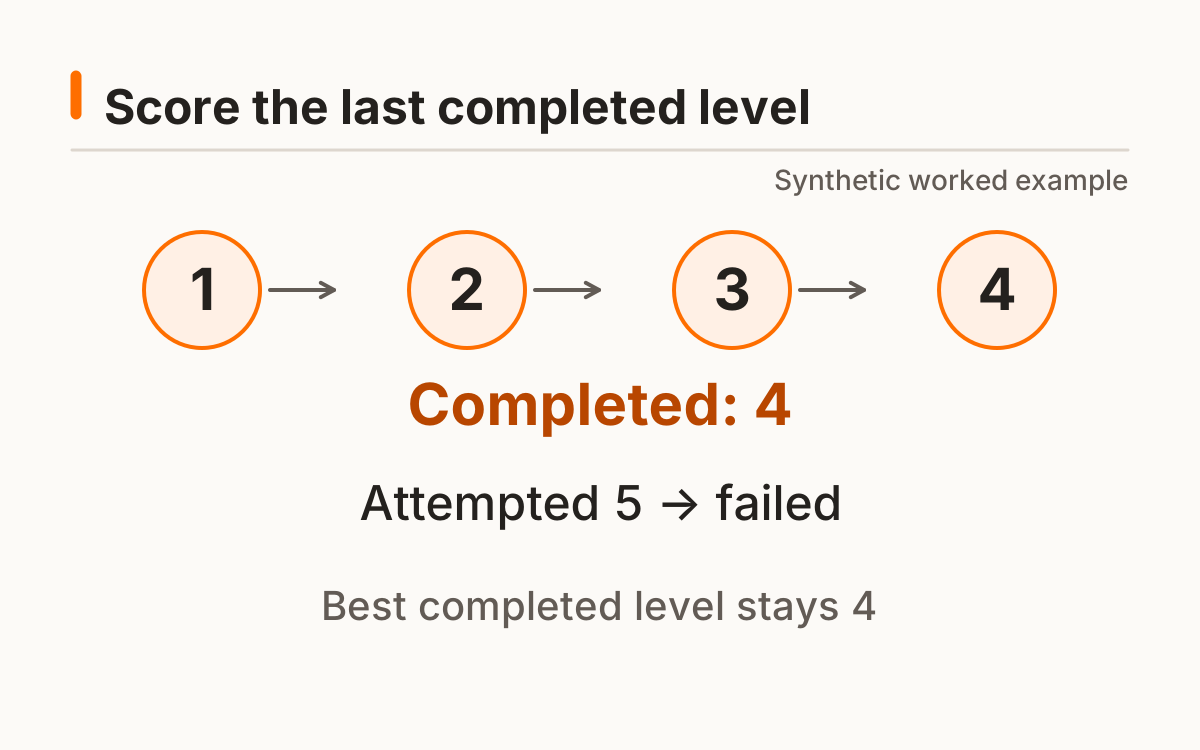
A level in this chimpanzee test is the number of positions successfully recalled in one complete round. Completing level four and then missing at level five leaves the highest completed score at four. Attempting a harder layout does not itself increase the result.
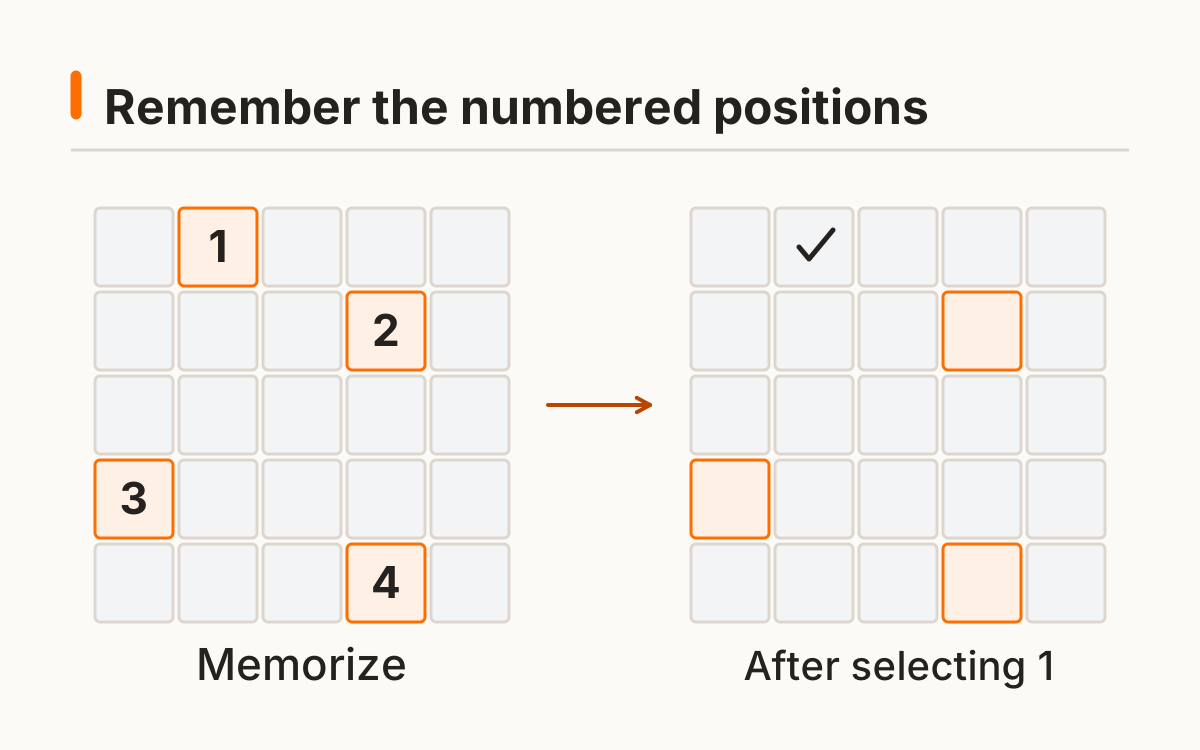
The grid samples distinct cells without replacement so two numbers never share a location. After the labels hide, accessible cell labels identify locations without revealing the hidden answer. Keyboard mode supports arrow-key movement and Enter or Space selection.
A failure does not erase an already completed level. It uses one of three failures and offers the same level again with a fresh layout. Attempting a harder round alone does not raise the score.
| Round outcome | Highest completed level |
|---|---|
| Complete 1–4 in order | 4 |
| Attempt 1–5 but make a mistake | Still 4 |
| Later complete 1–5 in order | 5 |
How should you compare two attempts?
Keep the grid size, starting level, study-time rule, label-hiding rule, and input method consistent when comparing two chimp test sessions. A larger display or a different input can change how the game feels even when the nominal level is the same.
Optional history records the protocol version and input. There is no account or public ranking. If you leave an active round, the game pauses and lets you begin that level again without charging a failure for the interruption.
Arrow keys move through cells in keyboard mode; Enter or Space selects. After hiding, accessible names identify cell locations without revealing their numbers. The chimp test preserves the same label-hiding rule across input modes.
What can this game say about memory?
This game describes performance at remembering numbered spatial locations under its own rules. It does not establish an IQ score, a clinical assessment, or a comparison with any animal study. The chimp test name is a familiar description of this game format, not a claim to reproduce a research procedure.
Use the sequence game if you want to replay a displayed order, or word recognition if you want Seen/New decisions. Different memory tasks produce different scores. Familiarity with a game can affect later attempts without demonstrating a general change in memory ability.
A local best under v1.0 should not combine a different grid, study limit, or failure rule. Those define the game. This is a repeatable original activity, not a standardized memory scale or a cross-species comparison.
Frequently asked questions
Is this an intelligence test?
No; it is an original memory game.
When do labels disappear?
After the first correct tile is selected.
Is study time limited?
Not in this protocol; that rule is stated beside the game.
What happens after a wrong tile?
The round fails; three failed rounds end the session.
Can I compare it with another website?
Only if grid, hiding, study-time and failure rules match.
Sources and method
This is an original game with explicit v1.0 rules, rather than a reproduction of a clinical or research test. No empirical norm or external dataset is used.
Published October 20, 2026 · human-reactiontimetest.com · Report a correction