
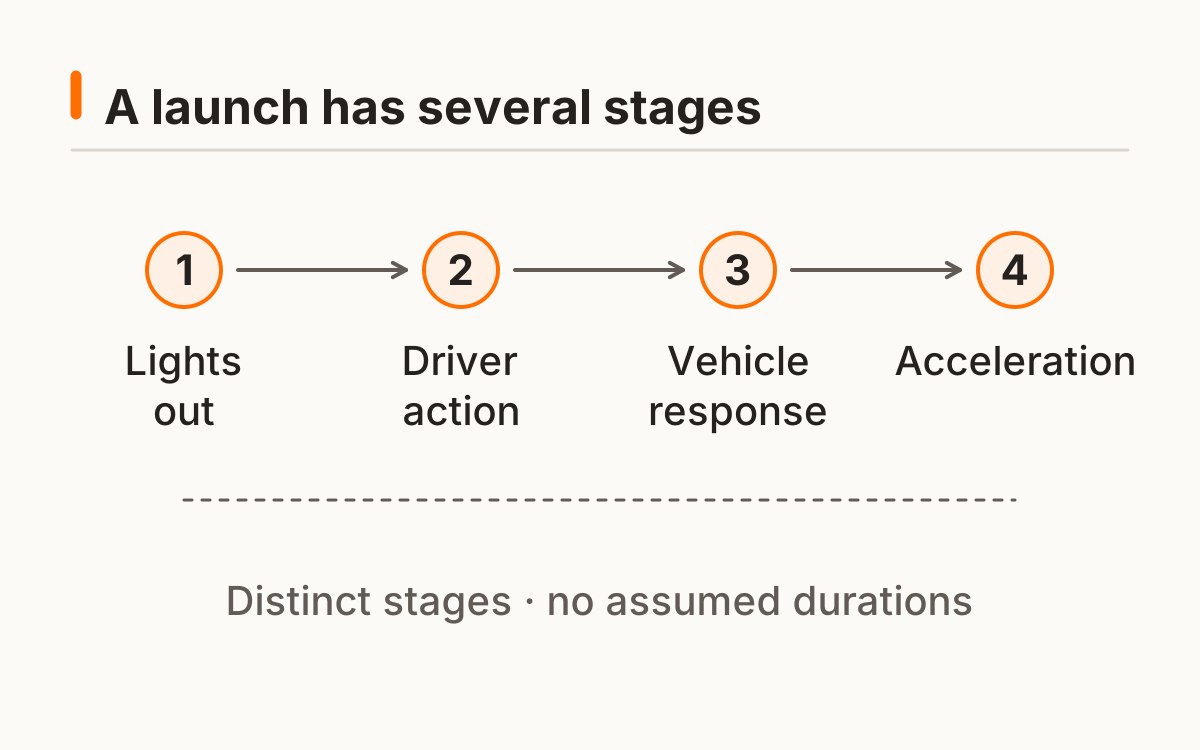
Try the method in f1 reaction test. The challenge is an independent simulation with no Formula 1 affiliation.
What does f1 driver reaction time include?
F1 driver reaction time is one part of a larger start procedure. A response to lights-out, a control input, and the car beginning to move are different possible endpoints. A time is interpretable only when the source identifies which of those events it measures.
A complete launch also depends on the car and track conditions. A browser challenge keeps only a simplified signal-and-input task. The distinction prevents a neat-looking millisecond number from implying that the website has measured a real race start.
F1 driver reaction time can compress several measurements into one label. Identify what triggered the clock and what stopped it. A source that cannot answer those questions does not support a precise comparison merely by printing decimals.
Can a browser score measure f1 driver reaction time?
A browser measures a software cue to an input event. It does not observe a driver, clutch position, vehicle motion, or traction. Converting a browser score into F1 driver reaction time would require a comparable measurement definition and validated event data; this site has neither and does not produce that conversion.
F1 reaction time: what happens after lights-out?
After lights-out, the launch involves operating the car and managing the getaway. An F1 reaction time broadcast graphic may describe only one segment of that chain. Check its definition before treating it as a complete launch measurement.
The original Formula 1 explanation of race starts describes several procedural and driver tasks. This guide uses that context rather than presenting a fictional universal driver average. The illustration separates the cue, response, control action, and vehicle launch without assigning unsupported durations.
A broadcast sequence can illustrate a launch without being a calibrated record. Preserve its timing definition and event context. This guide explains stages without extracting unsourced millisecond values from video frames.
| Browser challenge | Race-start question |
|---|---|
| Software lights-out cue | Which physical or broadcast event defines lights-out? |
| Accepted pointer or key event | Which driver or vehicle event defines the endpoint? |
| Device delay uncalibrated | What timing equipment and correction were used? |
| One original game protocol | What event, car, and procedure were involved? |
For the original discussion of race-start procedures, see Formula 1’s explanation. It is context for racing, not a benchmark dataset for this game. Formula 1: Why race starts are so critical.
Average f1 driver reaction time: which evidence is needed?
An average F1 driver reaction time claim needs a named original source, event, sample, and timing definition. A list of numbers without those details cannot establish a comparable driver ranking. Even a sourced number should retain its event and method instead of becoming a universal trait.
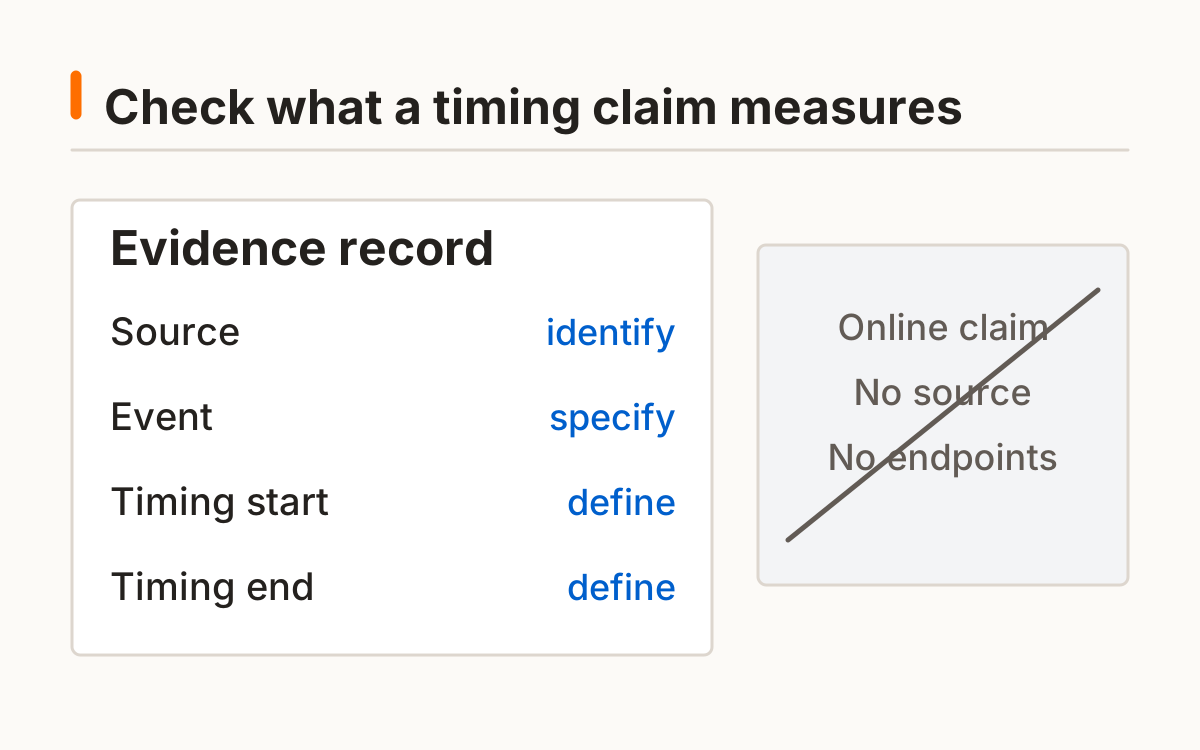
Before using a broadcast value, identify whether it records a control action, wheel movement, or another event. Keep equipment correction and any exclusion rules visible. This guide does not fill missing data with guesses or infer an official racing penalty from a guessed millisecond cutoff.
An average F1 driver reaction time also needs the number of starts and inclusion rules. A single selected event differs from a summary across a defined set. Missing methods should stay unknown rather than being guessed from a headline.
- Original event and date.
- Defined start and end events.
- Timing source and any corrections.
- Comparable drivers, trials, and inclusion rules.
Which start comparisons are actually useful?
Compare browser lights-out sessions with your own earlier sessions under the same protocol. Compare racing measurements only when their original definitions and event context support it. These are two separate uses of timing information.
The linked challenge is an independent simulation with no Formula 1 affiliation. Its score does not place you on a driver leaderboard. Use the launch-stage diagram to understand the difference, and keep unsupported F1 driver reaction time claims out of your personal baseline.
Describe a browser score as a lights-out game result with its device and input. Describe a racing value with its original event and definition. This keeps a personal challenge from becoming an unsupported driver or vehicle claim.
Frequently asked questions
Are internet driver rankings reliable?
Use only records with a named original source, event and timing definition.
Does the fastest response guarantee the best start?
A complete launch involves other actions and conditions.
Can this site rate me against a driver?
It lacks a comparable validated dataset for that comparison.
Is a browser score measured at the wheels?
No; it records a browser signal-to-input interval.
Where can I try lights-out practice?
Use the separate independent F1 challenge linked below.
Sources and method
Formula 1: Why race starts are so critical. Read this source within its own method; the protocol and synthetic examples on this page describe this site’s implementation.
Published October 20, 2026 · human-reactiontimetest.com · Report a correction