
Try the method in click test. Keep the task and input settings visible when comparing results.
What does average cps describe?
Average CPS describes a summary of click rates. Before using the word average, identify whether you mean one run’s count per second, an arithmetic mean of run rates, or pooled clicks over pooled time. These quantities can differ when run durations differ.
This page explains your own calculations. It does not supply a representative population norm, gamer percentile, or universal target. The click tool is the place to collect matching manual-input runs; this guide explains how to read them.
Average CPS is ambiguous unless the averaging unit is named. Trials, time windows, and participant summaries answer different questions. Retain original counts and durations so your chosen calculation can be reconstructed later.
How is average cps calculated for a run?
For one run, divide accepted clicks by the selected window in seconds. Fifty clicks in ten seconds give 5 CPS. The denominator is the full defined window, not the gap between the first and last click. A meaningful comparison preserves that rule and the input method.
Average clicks per second: which duration is fair?
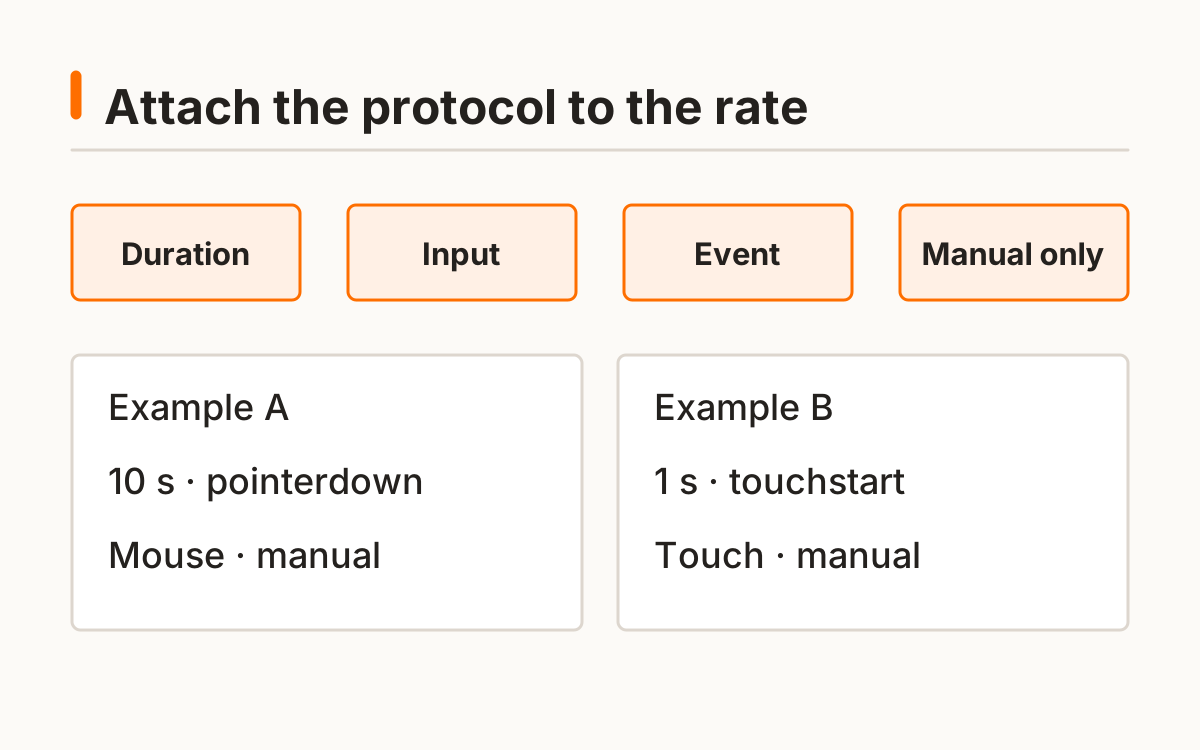
Use the same duration when comparing average clicks per second across ordinary runs. A one-second burst and a sixty-second run share units, but their windows ask different practical questions. Input technique and device must also be labeled.
A fair comparison keeps mouse runs separate from touchscreen runs. If you deliberately compare durations, report the durations alongside the rates and say that the protocol changed. Do not hide that change behind a single average CPS number.
Equal-duration runs also need matching event rules. Counting press and release as two actions differs from counting pointerdown once. Preserve that rule before comparing rates across tools or techniques.
What is the average clicks per second across your sessions?
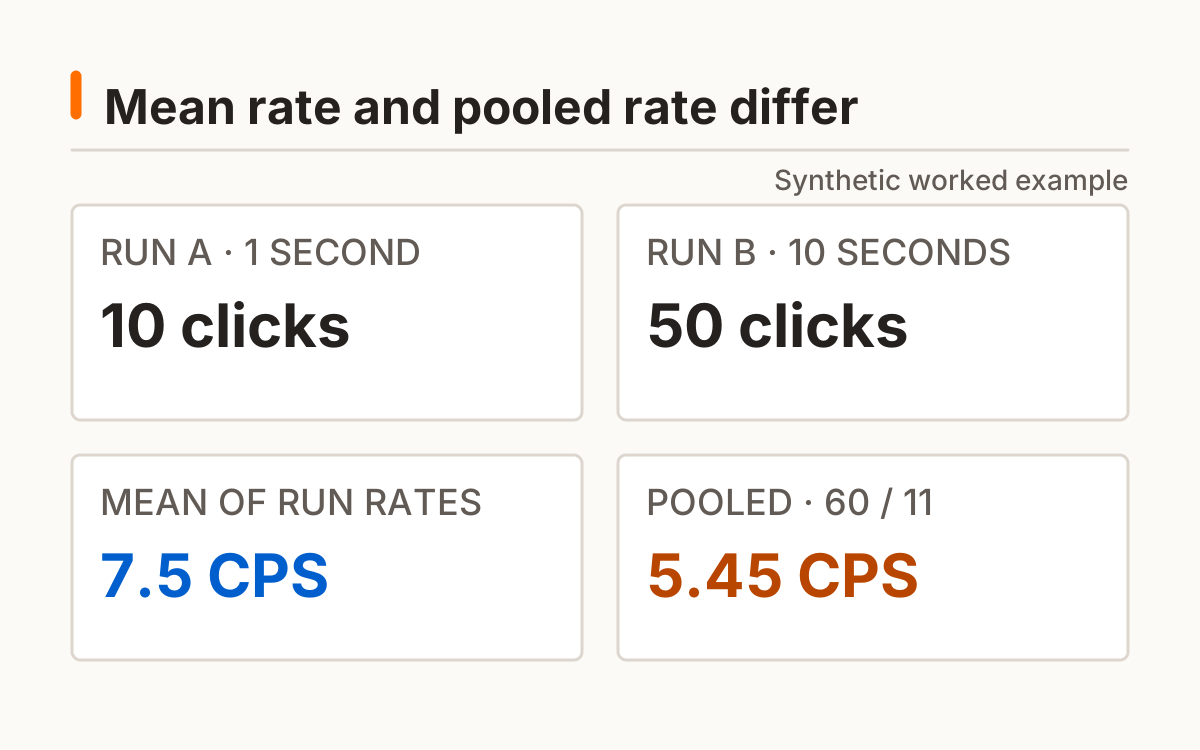
Choose a statistic according to the question. An arithmetic mean gives each run’s rate equal weight. A pooled rate adds all clicks and divides by all recorded time, giving longer windows more weight. Neither should be presented without naming the method.
In a synthetic example, run A has 10 clicks in 1 second and run B has 50 clicks in 10 seconds. The rates are 10 and 5 CPS. Their arithmetic mean is 7.5 CPS, while the pooled rate is 60 ÷ 11, about 5.45 CPS.
For equal durations, the arithmetic mean of rates and the pooled rate coincide. With unequal durations they can differ because pooling gives more weight to time. State whether runs or recorded seconds should contribute equal weight.
| Statistic | Calculation | Worked result |
|---|---|---|
| Run A | 10 ÷ 1 | 10 CPS |
| Run B | 50 ÷ 10 | 5 CPS |
| Mean of run rates | (10 + 5) ÷ 2 | 7.5 CPS |
| Pooled rate | (10 + 50) ÷ (1 + 10) | About 5.45 CPS |
Frequently asked questions
Is CPS a reaction-time measurement?
No; it is repeated input rate rather than signal-to-response delay.
Can I average two rates?
Yes, but equal weighting and pooled time-weighting answer different questions.
Does CPM need another tool?
The click page reports CPM and offers a sixty-second mode.
Is a touchscreen norm supplied?
No verified population norm is claimed.
Are longer sessions always slower?
That would require evidence; preserve duration rather than assuming a rule.
Sources and method
The rate formulas and labeled examples on this page are arithmetic, not a population dataset. No empirical norm or external dataset is used.
Published October 20, 2026 · human-reactiontimetest.com · Report a correction