
Try the method in reaction time test. Keep the task and input settings visible when comparing results.
How should you choose the best online reaction time test?
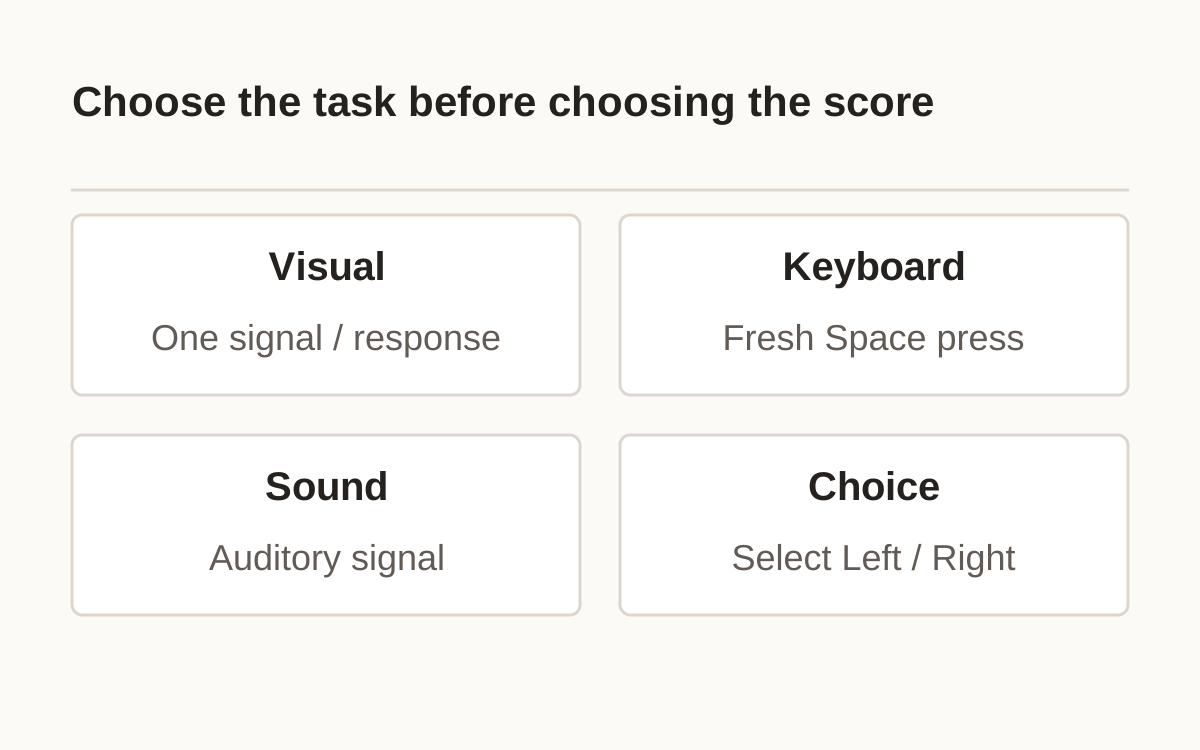
The best online reaction time test for a purpose has suitable cues, endpoints, input, and reporting. Choose one cue and response for a simple visual task. Choose mapped responses to add selection. An auditory task needs a sound cue and a recorded output route. Start with the task you want to repeat.
This page is a method chooser for the site’s implemented protocols, not a ranking based on independent competitor testing. A small number does not establish that the right interval was measured. Read the rules and results before comparing performance. Keeping errors and trial counts visible is part of understanding the outcome.
- Choose the cue and task.
- Match input to your setup.
- Read trial and timeout rules.
- Inspect results and data controls.
Does the best online reaction time test need a public percentile?
A useful tool matches a clearly described purpose. A universal winner would require compatible tasks and independent evidence. This guide chooses among actual site procedures instead of claiming unperformed comparative tests.
This documentation defines the monotonic software clock used for intervals; it does not calibrate physical display or input delay. MDN: Performance.now().
The original paper describes its own simple-response task and equipment calibration. Its measurements are not norms for this browser protocol. Woods and colleagues: Factors influencing the latency of simple reaction time (2015).
Best reaction time test: which protocol fits the question?
The simple visual tool completes five valid trials; the keyboard-specific version uses Space. The sound tool requires a preview and records its output route. Choice presents twenty cues with correct, wrong, and missed responses. GO/NO-GO includes correct withholding, which has no timed sample.
These methods differ intentionally. Aim adds target search and pointer movement. Click rate counts repeated actions. Their scores belong in separate categories, not one overall reaction rating. A smaller number from audio or keyboard does not establish that modality as universally fastest. Report the actual procedure that generated the result.
| Purpose | Site procedure |
|---|---|
| Single visual response | Five valid trials |
| Fresh keyboard response | Spacebar; five valid trials |
| Auditory cue | Preview, then five trials |
| Mapped choice | Twenty scored cues |
| Respond or withhold | Fourteen GO and six NO-GO |
Best reaction time test website: what evidence should it show?
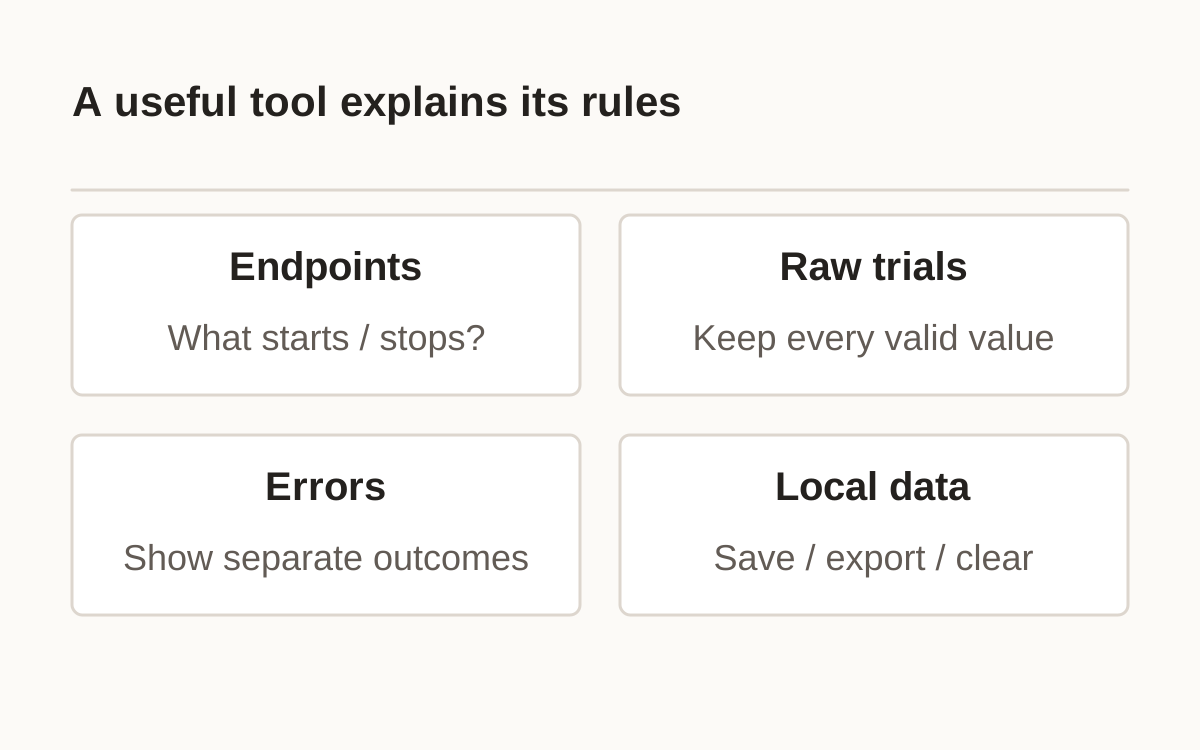
Inspect what the result retains. Early presses should be separate from valid times; errors without a response latency should not become zeros. The summary should state its sample. Focus loss, hidden pages, and input changes also need defined handling so the denominator remains understandable.
This site labels protocol 1.0 and provides session results, optional local history, and CSV export. Saving starts off; enabling it stores completed results in the current browser. Those are inspectable implementation features. They do not prove physical calibration or guarantee identical measurement behavior on every device and browser.
How can you compare tools without ranking incompatible scores?
For a personal comparison, choose one task and setup before collecting sessions. Retain compatible records and note changes in browser, input, device, or display. Read latency alongside errors; a fast attempt with many wrong choices describes different behavior from an accurate attempt with similar timing.
For research, clinical assessment, recruitment, or another consequential use, identify evidence appropriate to that setting. A casual tool does not inherit validation from a familiar task name. This guide provides a transparent recreational starting point, without an independently tested website ranking, clinical interpretation, or universal performance promise.
Frequently asked questions
Were other websites independently latency-tested here?
No. This comparison describes documented protocols and evaluation criteria.
Which method is the right default for a visual baseline?
Use a clearly defined simple visual task with a fixed input and visible trial rules.
Are more modes always better?
Only if each mode’s purpose and scoring are clear.
Does a percentile prove scientific validation?
No. Its dataset and comparability still need evidence.
Are there affiliate placements in this comparison?
No. The method links and citations are ordinary editorial references.
Sources and method
- MDN: Performance.now() · checked 2026-10-21. Read within its original procedure; this site’s examples and rules are separate.
- Woods and colleagues: Factors influencing the latency of simple reaction time (2015) · checked 2026-10-21. Read within its original procedure; this site’s examples and rules are separate.
Published October 21, 2026 · human-reactiontimetest.com · Report a correction