
Understand this result with reaction time test. Keep the task and input settings visible when comparing results.
How does the f1 reaction test start?
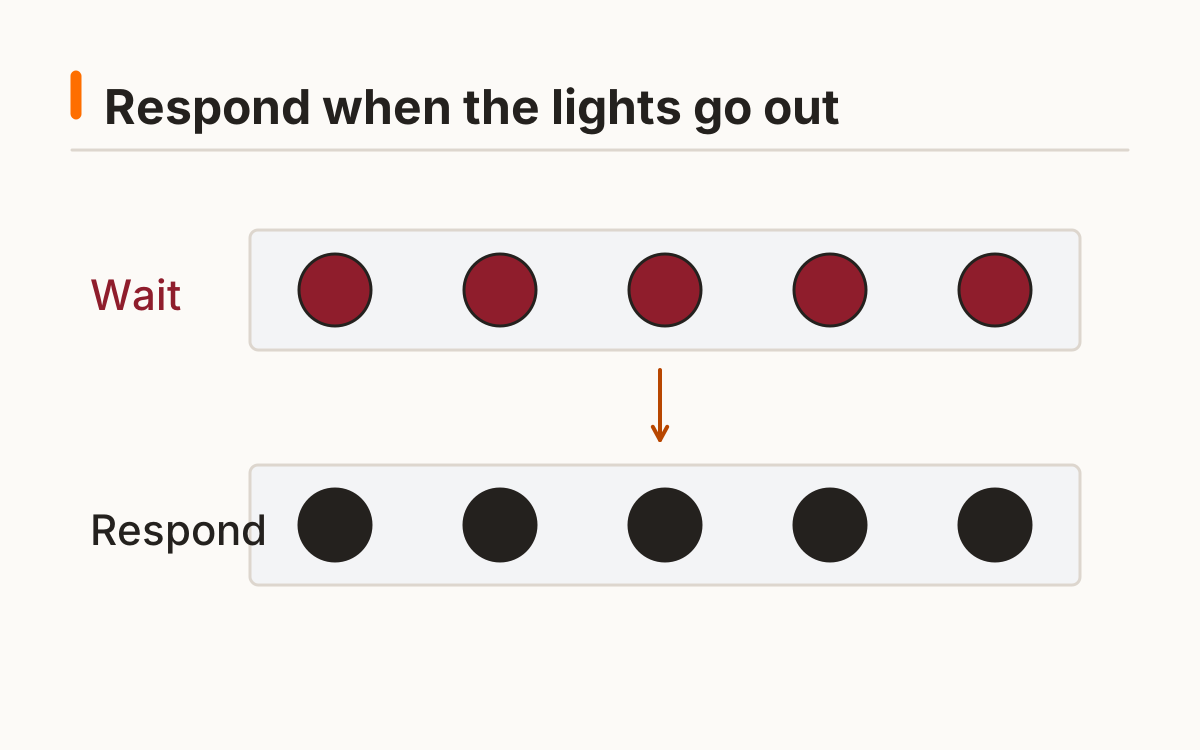
The f1 reaction test begins with five original light circles. One illuminates each second; after the fifth is on, a random wait of 0.8–3.0 seconds precedes lights-out. Your response interval begins when the browser updates all five to off.
Choose mouse, touch, or keyboard before the session. Complete five valid attempts to see the median, mean, best, range, raw values, and jump-start count. These delays are the rules of this browser challenge, rather than a transcription of current race regulations.
- Start the light sequence.
- Let all five lights illuminate.
- Respond only when all five have extinguished.
- Repeat until five valid trials are complete.
The f1 reaction test pairs the extinguished lights with an explicit “Lights out” message. There is no CSS fade on the measured cue. Software updates define the recorded onset; the physical display still has uncalibrated delay.
What is a jump start in this f1 reaction test?
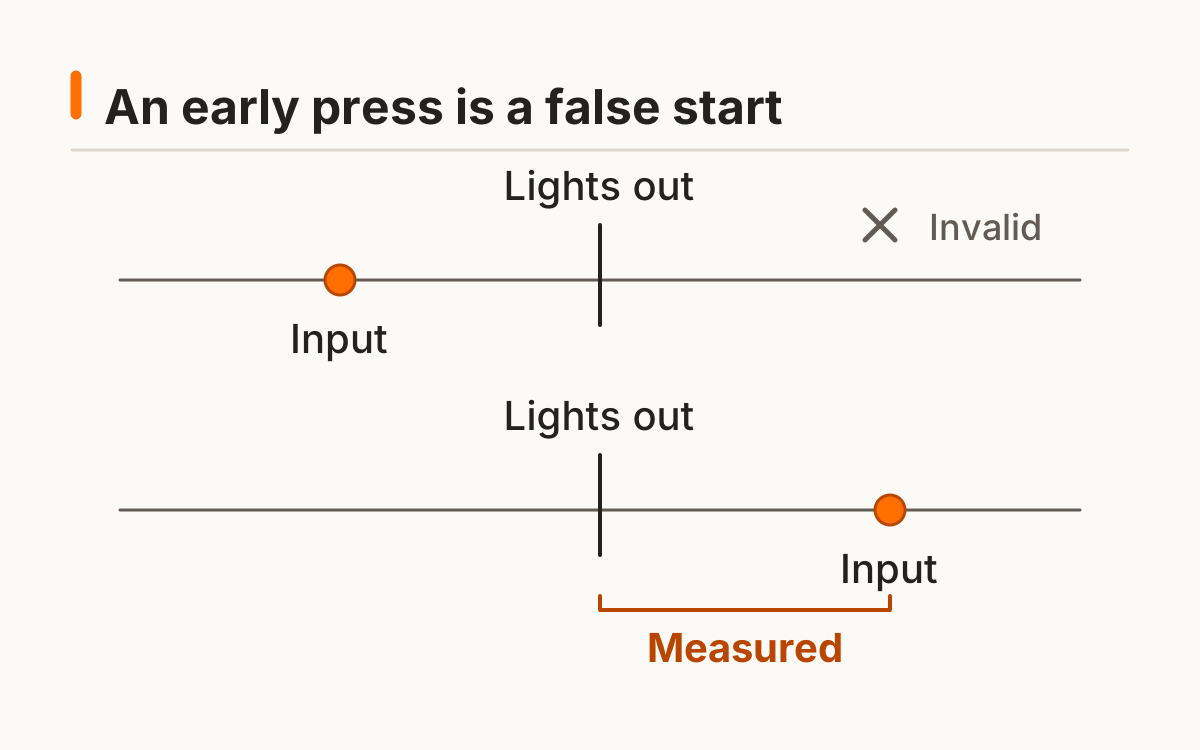
A jump start in this game is a response before the five lights go out. It ends that round without adding a latency to the valid sample. Start the round again and wait for the actual signal. The game does not apply a racing penalty or interpret an under-100-ms score as an official regulation violation.
F1 start timer: when should you press?
Press after the lights go out, rather than after a predicted number of seconds. The random final wait makes a memorized countdown less useful. The F1 start timer records the software lights-out event and your accepted input; it does not use a green light as an additional signal.
A synthetic software timestamp of 1,000 ms for lights-out and 1,250 ms for input yields 250 ms. An earlier press is a jump start, not a negative result. Reset or leaving the active window cancels pending callbacks so an abandoned sequence cannot later create a score.
Pressing during any part of the light sequence adds a jump start. You do not need to wait through the rest of an invalid round. Restart when ready and retain the early-response count beside the five valid intervals.
F1 reaction time test: how close is this to racing?
A browser F1 reaction time test models only a simple response to a lights-out cue. It does not reproduce a cockpit, clutch control, vehicle motion, traction, or communication with a racing team. A quick press here cannot be converted into a driver launch time.
Formula 1’s own race-start explanation describes a launch as a procedure involving several actions and decisions. That context supports keeping a browser score separate from a complete getaway. This is an independent challenge with original graphics and no official Formula 1 affiliation.
The F1 reaction time test uses its own light steps and final wait range. Those settings are game rules, not evidence of current sporting regulations. Keep a real race’s procedure and this simplified task separately defined.
For the original discussion of race-start procedures, see Formula 1’s explanation. It is context for racing, not a benchmark dataset for this game. Formula 1: Why race starts are so critical.
How can you compare repeated sessions?
Compare repeated f1 reaction test sessions using the same input and device. Retain all five valid intervals and the separate jump starts. A small isolated value may reflect a well-timed guess; a full session gives more useful context without proving a biological limit.
If the panel loses focus, resume the cancelled round from a new sequence. Optional saved history stays in this browser and records the protocol and input. You can clear it or export it without creating an account. No driver ranking or public record is inferred from the result.
Retain a complete f1 reaction test session rather than only an isolated screenshot. Optional history stores the input and rule version. An export preserves the raw intervals for your own log without creating an official record or racing comparison.
Frequently asked questions
Is this an official Formula 1 test?
No; it is an independent browser challenge.
Why do the lights go off instead of green?
This challenge uses a lights-out signal; it is not a traffic-light task.
Does my score equal a driver launch time?
No; the tasks and hardware differ.
Can I press Space?
Yes; held-key repeats do not count as new responses.
Why is the delay random?
A variable wait reduces the usefulness of timing a predictable sequence.
Sources and method
Formula 1: Why race starts are so critical. Read this source within its own method; the protocol and synthetic examples on this page describe this site’s implementation.
Published October 20, 2026 · human-reactiontimetest.com · Report a correction