
Try the method in mouse response time. Keep the task and input settings visible when comparing results.
What should a reaction time test machine measure?
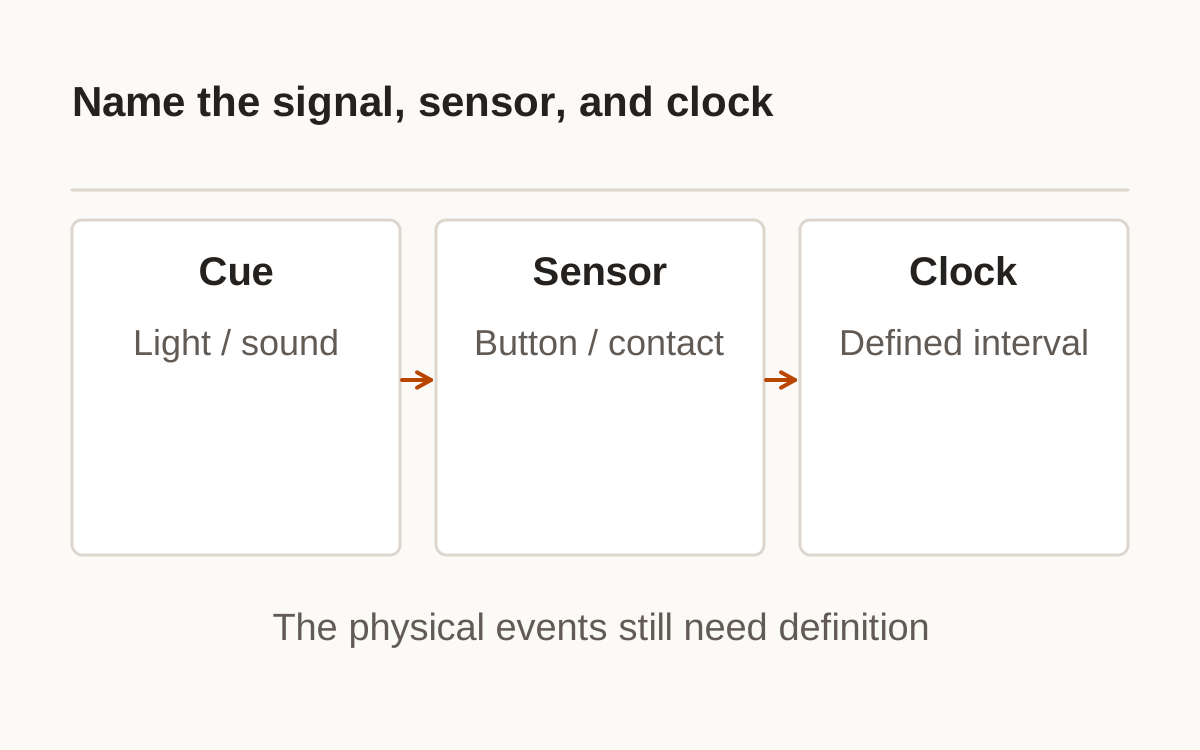
A reaction time test machine combines a cue, response sensor, and clock. The details determine its outcome. A light may trigger a button response, a sound may trigger another action, and a ruler activity infers time from distance. Name the physical events that start and stop timing.
A useful method identifies cue generation, onset detection, the accepted response, and clock. Timestamping a command to show a light is different from sensing the light itself. That distinction belongs in the documentation. Browser software has the same need to describe what its timestamps directly observe and what remains inferred.
- Identify cue and sensor.
- Define both endpoints.
- Inspect invalid-response handling.
- Ask for calibration evidence.
Does a dedicated reaction time test machine remove hardware delay?
Two devices called reaction timers can use different cues, sensors, and start events. Read their procedures and calibration evidence before comparing reported milliseconds. A product label does not define the measurement.
The original paper describes its own simple-response task and equipment calibration. Its measurements are not norms for this browser protocol. Woods and colleagues: Factors influencing the latency of simple reaction time (2015).
Reaction time test equipment: which components define the task?
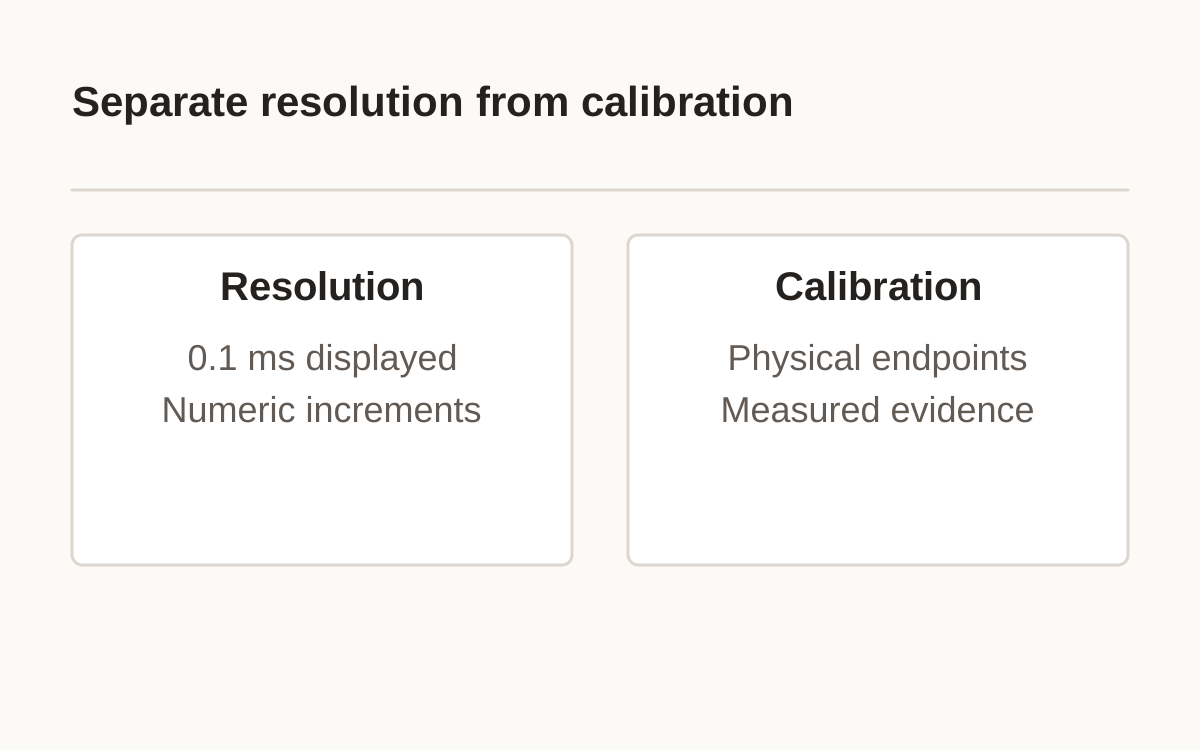
Resolution describes recorded or displayed increments. Calibration concerns agreement with a suitable reference for the measured events. A synthetic readout to 0.1 ms has fine numerical increments, but does not prove physical light and switch timing within 0.1 ms. Consistent values can retain an unknown offset.
Ask how reference events are generated and observed, which conditions were checked, and whether uncertainty describes the complete path. A component’s specification cannot automatically characterize the assembled system. These are evaluation questions, not a calibration certificate or correction factor for equipment you own.
| Term | Question |
|---|---|
| Resolution | Which increments are displayed? |
| Repeatability | How consistent are repetitions? |
| Calibration | How does it agree with a reference? |
| Endpoints | Which physical events are timed? |
NASA describes a partner-assisted drop-and-catch activity. Keep its physical procedure distinct from a browser signal task. NASA: Measure Your Reaction Time.
Reaction time test device: how should calibration be described?
A research program and a sports device can target different tasks. One may control response mapping; another may include reaching toward a target. Those movements change the measured outcome. Their numbers cannot be assumed to time identical events.
Woods and colleagues describe their own simple-response method and timing considerations in the cited original research. That paper does not validate every reaction timer or calibrate this website. If a named instrument matters, read its exact version and original procedure rather than substituting a similar-looking interface or borrowing its norms for another product.
Which questions should you ask before comparing equipment?
Before buying, identify required modality, sensor, accessibility, trial export, invalid-response rules, supported setup, and measurement documentation. Ask the supplier about unknown items. A demo can establish usability while physical timing claims require appropriate measurement evidence.
This page has not tested or ranked products and names no fastest machine. Keep supplier claims attributed until verified. A browser game can help explain task definitions, but cannot certify equipment latency or replace model-specific documentation. Record exact model, firmware, sensors, and protocol in a comparison so later changes do not silently alter the method.
Frequently asked questions
Is a light board the same as a simple button task?
Not necessarily. Reaching, target choice, and movement can change the task.
Does a digital display prove accuracy?
The displayed resolution does not itself establish calibration of the measurement chain.
Are product recommendations or prices supplied?
No. This guide gives device-evaluation questions rather than an untested shopping ranking.
Can a ruler be useful equipment?
Yes, for its stated partner-assisted procedure and free-fall assumptions.
What should accompany an adjusted score?
The original method and how the equipment correction was measured.
Sources and method
- Woods and colleagues: Factors influencing the latency of simple reaction time (2015) · checked 2026-10-21. Read within its original procedure; this site’s examples and rules are separate.
- NASA: Measure Your Reaction Time · checked 2026-10-21. Read within its original procedure; this site’s examples and rules are separate.
Published October 21, 2026 · human-reactiontimetest.com · Report a correction