
Try the method in reaction time test. Keep the task and input settings visible when comparing results.
What does reaction time describe?
Reaction time describes an interval between a signal and a defined response onset. The definition becomes useful when the stimulus, required response, and timing apparatus are explicit. “Press a button when a panel changes” and “choose the correct button from several options” ask different questions.
A browser operationalizes those endpoints as software events. It can subtract timestamps, but it cannot separately observe perception, decision, muscle activity, display illumination, and switch activation from that pair of timestamps alone. State the task before attaching significance to the number.
A panel update and a pointerdown listener are observable software endpoints for reaction time. They are not direct recordings of the instant someone perceives light or begins muscle activity. Those processes contribute to performing the task but are not separately measured.
Which events define a reaction time interval?
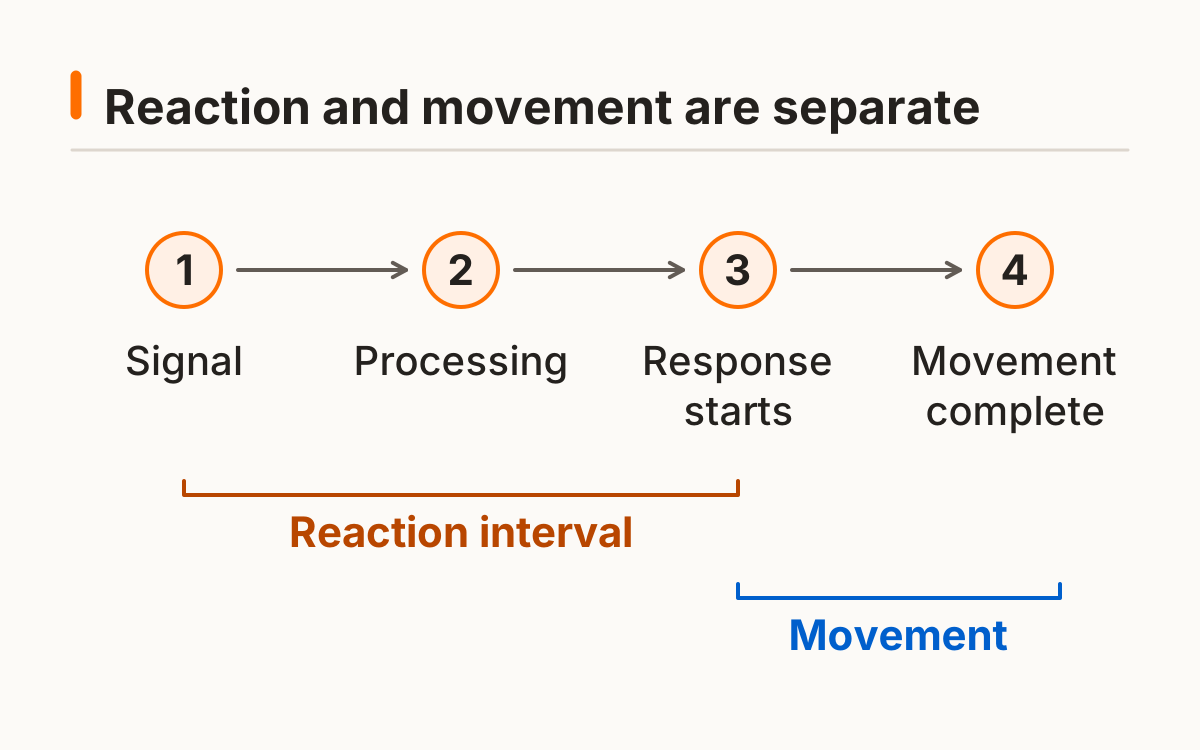
Define both endpoints before subtracting timestamps. In a synthetic example, a stimulus at 1,000 ms and response start at 1,240 ms give a 240 ms interval. A movement completed at 1,600 ms does not change that calculation because completion is outside this definition. Browser software events are practical endpoints, not direct recordings of individual neural stages.
For research context, this original paper describes its own simple-response methods and equipment timing. Its findings do not calibrate this browser task. Woods and colleagues: Factors influencing the latency of simple reaction time (2015).
Reaction time definition: how is movement different?
Movement time continues beyond response initiation toward completion of an action. A reaction time definition that ends at the start of movement does not include the full trip to a target. Conversely, a target-hit task may deliberately include that trip because its endpoint is the successful hit.
The distinction matters when a result looks unusually long or short. You may be comparing intervals with different endpoints rather than different response ability. Write “signal to button event” or “target appearance to hit” in a session log so the definition stays clear.
Reaching across a desk illustrates why endpoints matter: response initiation and the hand arriving are distinct events. A timer ending at arrival includes travel. Ask whether each reported value ends at initiation, a switch event, or successful selection.
| Interval | Start | End |
|---|---|---|
| Response interval | Defined stimulus | Defined response start |
| Movement interval | Movement start | Movement completion |
| Target-hit interval | Target appears | Target successfully selected |
What is reaction time in a simple versus choice task?
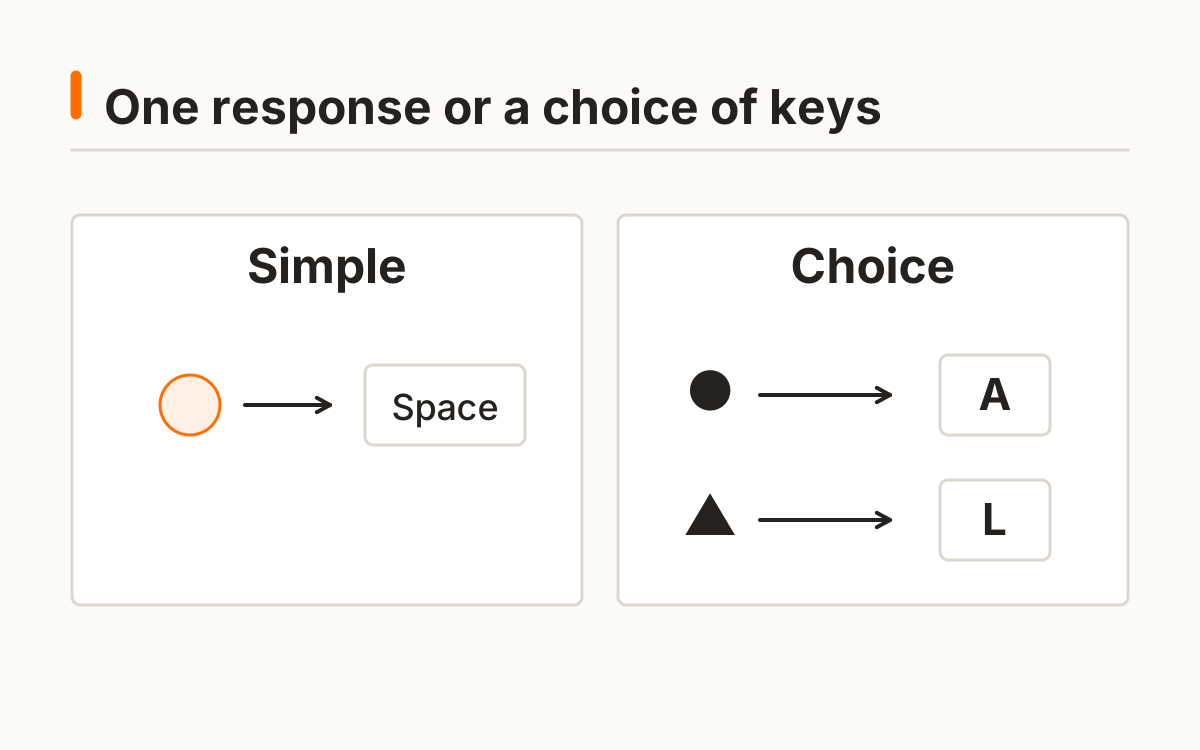
A simple task pairs one signal with one known response. A choice task requires selecting a response according to the signal. Reaction time in these tasks should not be pooled without describing the additional selection demand and the exact measurement method.
A voluntary response to a display is also different from an involuntary reflex. Everyday terms such as reflex test can obscure this distinction. This site uses original browser games with stated endpoints and does not infer intelligence, clinical status, or isolated neural processing speed.
A reflex, simple voluntary response, and choice response need separate descriptions. The phrase reaction time should not conceal those differences. Even a simple task needs its timing apparatus and acceptance rules identified before comparing numbers.
Where can you try a repeatable browser task?
Try a repeatable browser task when you want to record your own short series. Keep the input, device, and signal consistent, then retain the median, mean, raw trials, and false starts. A consistent definition is more useful than a single unexplained reaction time number.
Choose the visual test for a basic signal response, the lights-out challenge for its stated sequence, or the aim task for target acquisition. These are separate activities. Compare like with like and use research only with its original task and equipment context.
A short but specific note is enough: visual cue, mouse pointerdown, five valid trials, and protocol version. That distinguishes this task from an audio cue or thirty-target set. It also explains why incompatible records belong in separate groups.
Frequently asked questions
Is reaction time the whole movement?
The definition here ends at response start, not movement completion.
What unit is used?
Milliseconds; 1, 000 milliseconds equal one second.
Does a faster score mean higher intelligence?
This site does not make that inference.
Can two test types be compared directly?
Only with attention to their different signals, choices and timing methods.
Is one attempt enough?
A short series provides more context than a single lucky or distracted response.
Sources and method
Woods and colleagues: Factors influencing the latency of simple reaction time (2015). Read this source within its own method; the protocol and synthetic examples on this page describe this site’s implementation.
Published October 20, 2026 · human-reactiontimetest.com · Report a correction