
Try the method in reaction time test. Keep the task and input settings visible when comparing results.
Are reaction time tests accurate for their stated endpoints?
Reaction time tests can describe a defined software interval while leaving physical timing uncalibrated. A cue update and an input-handler timestamp are observable software events. Light reaching an eye and physical switch activation are different events that this browser does not independently sense.
A monotonic clock supports elapsed-time calculation without relying on wall-clock changes; it does not make the physical path known. Ask which measurement the procedure and evidence support. This site reports its software interval and task rules. It supplies no independently measured error margin for your setup or claim that its displayed decimals equal physical accuracy.
- Identify software endpoints.
- Distinguish physical events.
- Inspect trials and errors.
- Ask what was actually calibrated.
Are reaction time tests accurate enough to isolate a device delay?
The observed path contains human response, hardware, software, and display events. Without independent physical observations, a browser score cannot isolate one device delay or justify a numerical correction for it.
This documentation defines the monotonic software clock used for intervals; it does not calibrate physical display or input delay. MDN: Performance.now().
The original paper describes its own simple-response task and equipment calibration. Its measurements are not norms for this browser protocol. Woods and colleagues: Factors influencing the latency of simple reaction time (2015).
Accurate reaction time test: how do precision and calibration differ?
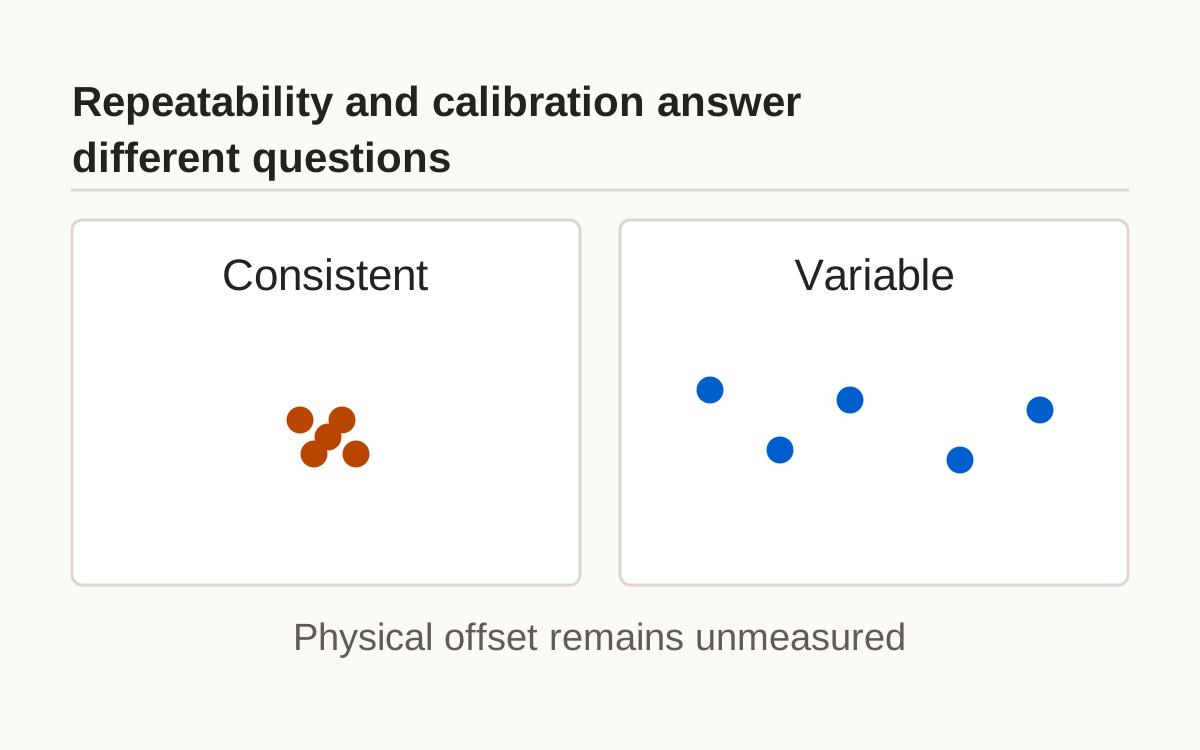
Precision, repeatability, and accuracy answer different questions. Displaying a decimal is a numerical format. Narrow trial spread describes consistency in that series. Agreement with a physical reference requires calibration evidence. One observation does not automatically establish the others.
As a synthetic example, adding 20 ms to every value shifts the series but preserves ordering and spread. That shows why repetition alone cannot reveal absolute offset. The example is not a measured error or a correction to your score. Real sessions can also differ in behavior, strategy, and equipment, so the explanation must stay within the available evidence.
| Observation | Interpretation |
|---|---|
| Decimal displayed | Reporting format |
| Narrow spread | Consistency in that series |
| Reference comparison | Agreement under tested conditions |
| Unknown offset | No justified correction |
Monitor reaction time test: why does refresh rate not tell the whole story?
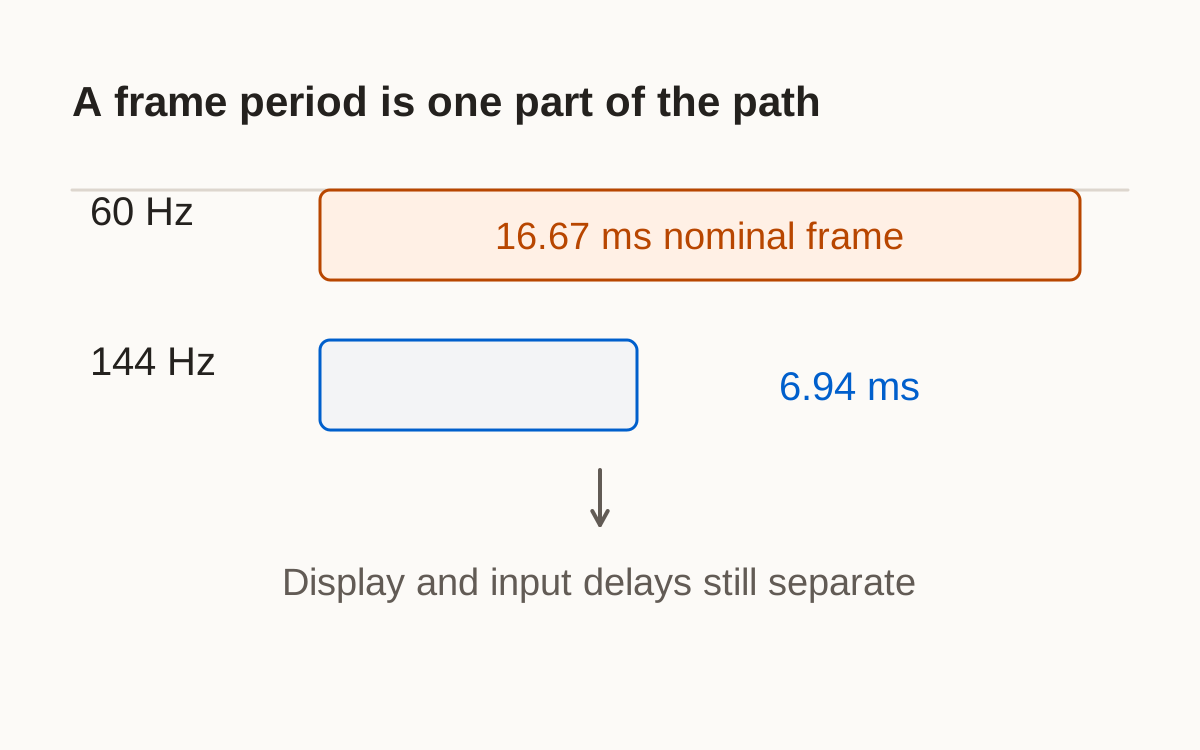
Refresh frequency gives a nominal frame period of 1000 ÷ Hz milliseconds: approximately 16.67 ms at 60 Hz and 6.94 ms at 144 Hz. These are periods, not total display latency or measured improvements in human response. They do not show precisely when a cue becomes physically visible.
An animation-frame callback is scheduled before repaint; it does not certify light onset. Input handling and display processing remain separate. Do not subtract one frame period from every score or invent device error bars from refresh rate. A recorded setting provides context, while calibration requires additional evidence.
The callback is requested before repaint and can pause in background contexts. It does not certify the physical onset of a display stimulus. MDN: requestAnimationFrame().
How should you interpret variation across devices and sessions?
Compare sessions with setup notes, raw values, and errors. A changed median can accompany changed input, task, display, or strategy. Repetition describes variation but does not identify its cause. The active rounds here cancel when focus is interrupted rather than counting an abnormal background wait as a regular presentation.
When physical accuracy is essential, select a method with appropriate reference instrumentation and documented uncertainty. For recreational logs, state the narrower browser question clearly. The original research cited here concerns its own experiment and equipment. It supplies no population norms or physical accuracy certificate for this site’s games.
Frequently asked questions
Does a decimal result prove physical accuracy?
No. Displayed precision and calibration of real events are different.
Can a stable bias remain in repeatable scores?
Yes. Repeating a setup does not by itself reveal its absolute offset.
Should I subtract one refresh interval from every score?
No. That would be an assumed correction rather than a measured one.
Can background activity affect the task?
Software scheduling and interrupted focus can affect a browser task; active rounds cancel on focus loss here.
Does this page promise a precise error margin?
No. No physical calibration has been performed for your setup.
Sources and method
- MDN: Performance.now() · checked 2026-10-21. Read within its original procedure; this site’s examples and rules are separate.
- MDN: requestAnimationFrame() · checked 2026-10-21. Read within its original procedure; this site’s examples and rules are separate.
- Woods and colleagues: Factors influencing the latency of simple reaction time (2015) · checked 2026-10-21. Read within its original procedure; this site’s examples and rules are separate.
Published October 21, 2026 · human-reactiontimetest.com · Report a correction