
Understand this result with chimp test. Keep the task and input settings visible when comparing results.
How does the sequence memory test work?
The sequence memory test starts with one randomly selected cell in a three-by-three grid. Watch it, then select the same cell. Each successful replay appends one cell to the existing sequence; cells may repeat.
Every flash lasts 500 ms with a 250 ms gap before the next. Three failed rounds end the session. A failed round replays the same sequence when you choose to retry, and the game finishes clearly if you complete the maximum length of thirty.
- Watch without entering a response during playback.
- Wait for the “Your turn” message.
- Repeat every cell in order, including repeats.
- Continue to a longer sequence after a complete replay.
The sequence memory test appends to the existing order after success. It does not replace the pattern with an unrelated one. Later levels therefore require retaining the earlier sequence and one new cell; repeated cells are allowed.
When can you respond in the sequence memory test?
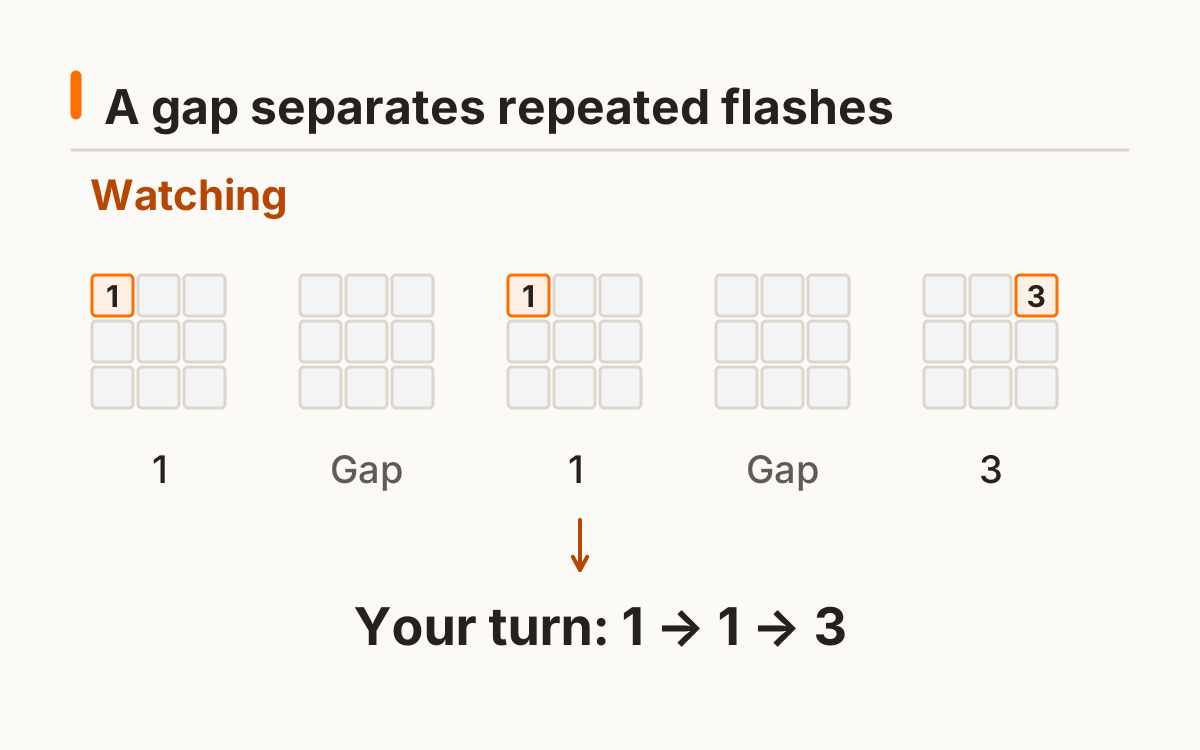
Wait until playback finishes and the page says “Your turn.” Presses during playback are ignored. A repeated cell is shown as separate flashes with a gap, so a sequence such as 1, 1, 3 must be entered as two selections of cell 1 followed by cell 3.
Sequence memory: what does the score count?
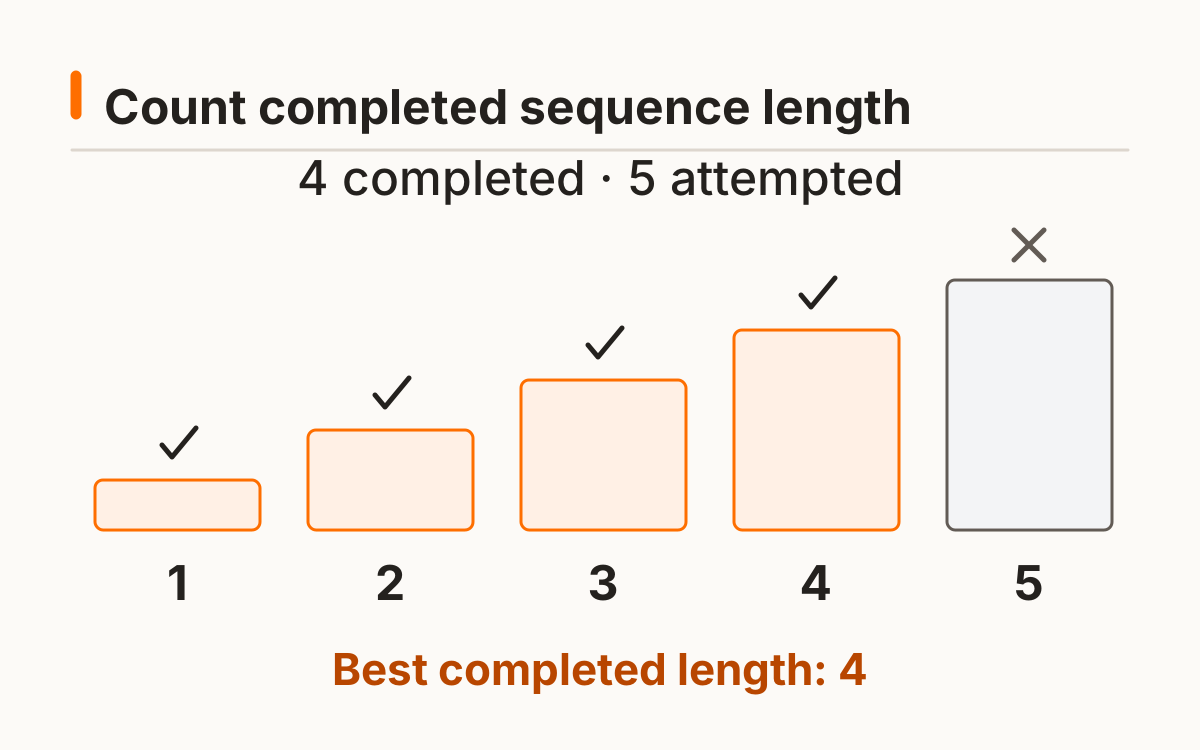
The sequence memory score is the longest sequence you fully complete. Completing length four and failing length five leaves a score of four. A partially entered longer pattern does not increase the result.
This makes the session count interpretable without treating an attempted level as an achievement. The game reports errors separately and uses its own versioned rules. It does not convert a completed length into IQ or compare it with an unspecified population.
A failed replay uses one failure and retains the sequence for retry. Completing that retry counts as a completed length; watching or partially entering a longer pattern does not. The score stays tied to a fully successful replay.
Sequence test: how does playback speed matter?
Playback speed changes the task, so a sequence test result needs its flash and gap durations. This protocol keeps both fixed. A repeated cell remains distinguishable because its highlight ends before the next flash begins.
The visible highlight uses an outline and fill change rather than relying on color alone. Keyboard mode maps keys 1–9 to the visible grid. Mouse and touch modes use the same order rules, but input labels remain distinct for comparisons.
Choose keyboard mode before playing and use 1–9 after playback. A held key’s repeat events do not add entries. The sequence memory test requires separate presses when one position occurs repeatedly in the pattern.
| Grid keys | Row |
|---|---|
| 1 · 2 · 3 | Top |
| 4 · 5 · 6 | Middle |
| 7 · 8 · 9 | Bottom |
How can you make sessions comparable?
Repeat the sequence memory test with the same timing, grid, input, and failure rules. A version with faster flashes or unlimited retries is a different protocol. Optional local history stores completed results with these settings rather than a universal memory label.
The numbered-grid game asks you to remember spatial locations after labels hide; this game asks you to replay an observed order. Try either for its own task, and keep their different score meanings visible. Leaving the active window pauses the current round without charging a failure.
Focus loss pauses the round without charging a failure. Resume its playback and keep the interruption in mind when comparing. Timing and retry rules matter alongside the final completed length.
Frequently asked questions
Can a cell repeat?
Yes; watch the gap between separate flashes.
Can I answer during playback?
No; wait for Your turn.
Is the score an IQ estimate?
No; it is a game-specific sequence length.
Does changing speed affect comparisons?
Yes; compare the same timing and protocol.
How is this different from numbered tiles?
You replay an order instead of remembering numbered spatial locations.
Sources and method
This is an original game with explicit v1.0 rules, rather than a reproduction of a clinical or research test. No empirical norm or external dataset is used.
Published October 20, 2026 · human-reactiontimetest.com · Report a correction