
Understand this result with reaction time test. Keep the task and input settings visible when comparing results.
How does the ruler reaction time test work?
The ruler reaction time test uses a partner to release a ruler while you try to catch it. Sit or support your arm, keep the ruler vertical, and align the starting mark with the point where you will read the catch. Your partner releases without a countdown.
Use an ordinary rounded ruler with clear markings. Do not substitute a heavy or sharp object. Enter the distance that fell before the catch, select centimeters or inches, and set the ruler length so impossible distances can be rejected.
- Support your arm and leave a small opening between finger and thumb.
- Have a partner hold the ruler vertically at the zero alignment.
- Wait for an unannounced release and catch it.
- Read the distance at the catch point and enter it.
Agree on the zero alignment before the series. A changed starting point means the same printed mark may represent a different fall distance. Keep that reading point consistent rather than correcting from memory after the catch.
How does a ruler reaction time test convert distance?
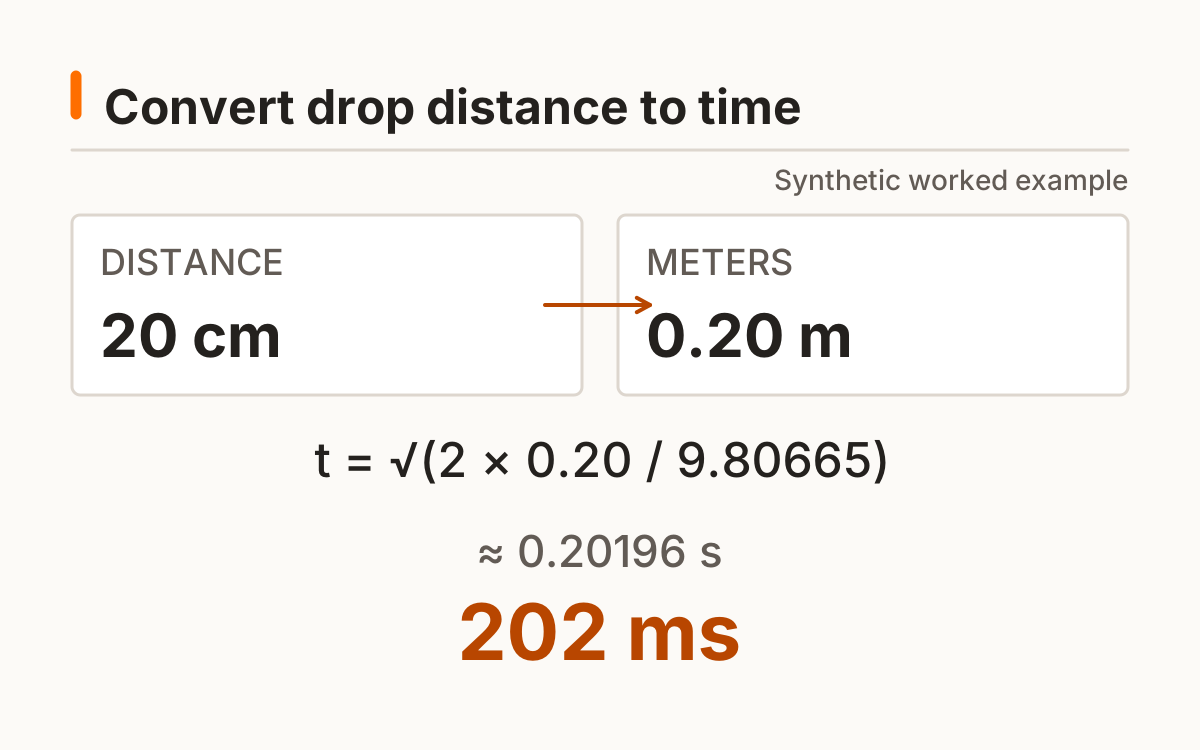
The conversion assumes free fall from rest: t = √(2d/g). Distance d is in meters, conventional g is 9.80665 m/s², and multiplying t by 1,000 gives milliseconds. Twenty centimeters therefore gives about 201.96 ms, displayed as 202 ms. The model estimates elapsed fall time, not a directly observed neural interval.
NASA’s educational activity describes a partner-assisted drop and catch. The calculator uses the free-fall formula and gravity constant stated on this page. NASA: Measure Your Reaction Time.
Reaction time test with ruler: which distance do you enter?
Enter the distance from the initial alignment to the catch point. In a reaction time test with ruler input, that is the fall distance, not the ruler’s total length. Select the unit before entering a value; inches convert to meters using 0.0254 m per inch.
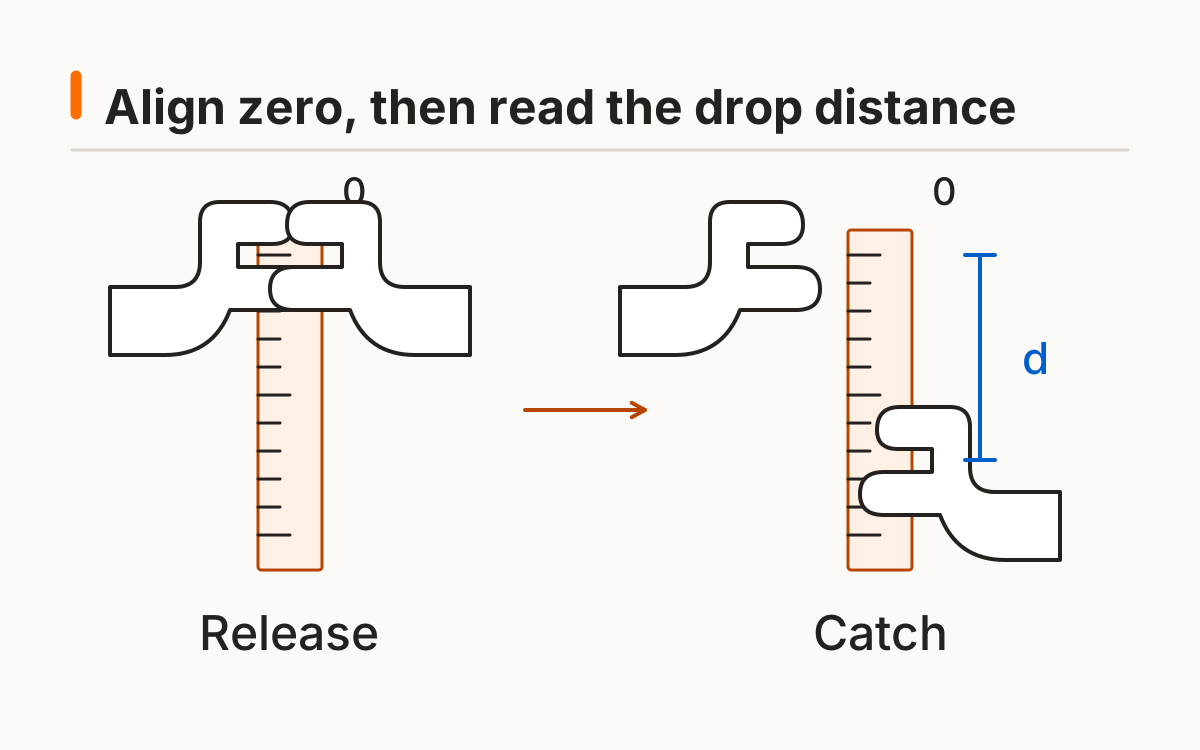
A 30 cm ruler cannot provide a valid catch distance beyond 30 cm. The calculator rejects negative, empty, non-finite, and over-length entries. Zero is allowed by the mathematical model, with a clear explanation that it is not a human zero-latency record.
The ruler reaction time test offers standard lengths or a custom length. That value is a validity limit, not the measured fall distance. It rejects over-length readings because the stated ruler could not supply them.
| Synthetic distance | Model time |
|---|---|
| 20 cm | About 202 ms |
| 30 cm | About 247 ms |
| 7.874015748 inches | About 202 ms |
Fitness test for reaction time: how do you repeat trials?
Repeat three to five catches using the same alignment, ruler, partner procedure, and reading point. This fitness test for reaction time is a simple educational activity with physical handling effects. Keep the catch distances and derived times rather than filling out a fictional laboratory report.
The calculator lists each time and displays the median. A miss that falls beyond the ruler length is not a measured catch distance; repeat the procedure rather than inventing an extrapolated value. A predictable countdown may encourage anticipation and should be avoided.
Twenty centimeters and about 7.874 inches describe the same distance. The calculator converts units before applying the square root, and keeps the unrounded estimates for its median. Only the displayed milliseconds are rounded.
What makes the estimate uncertain?
The estimate depends on release alignment, free fall, your catch mechanics, and how the distance is read. The ruler reaction time test does not isolate those effects from response initiation. The conventional gravity constant gives a stated model, not a guarantee that the physical drop exactly follows it.
Keep ruler estimates separate from browser scores. The cue, response, apparatus, and endpoint differ. Use the method for an approximate partner-assisted series, and retain the assumptions whenever you share the result.
Repeat the ruler reaction time test with the same physical setup. Reading and release differences can affect the estimate. Reporting raw distance, unit, ruler length, and the model makes it more interpretable than an unexplained millisecond value.
Frequently asked questions
Where do I read the ruler?
Use the catch distance from the initial alignment, following the procedure.
Can I use inches?
Yes; convert inches to meters using 0.0254m/in before calculation.
Is it the same as the browser score?
No; the stimulus, mechanics and apparatus differ.
Can a partner give a countdown?
A predictable cue can encourage anticipation; use an unannounced release.
Is the time exact?
It is an estimate based on free fall and the recorded catch distance.
Sources and method
NASA: Measure Your Reaction Time. Read this source within its own method; the protocol and synthetic examples on this page describe this site’s implementation.
Published October 20, 2026 · human-reactiontimetest.com · Report a correction