
Try the method in reaction time test. Keep the task and input settings visible when comparing results.
How to test reaction time with a defined method?
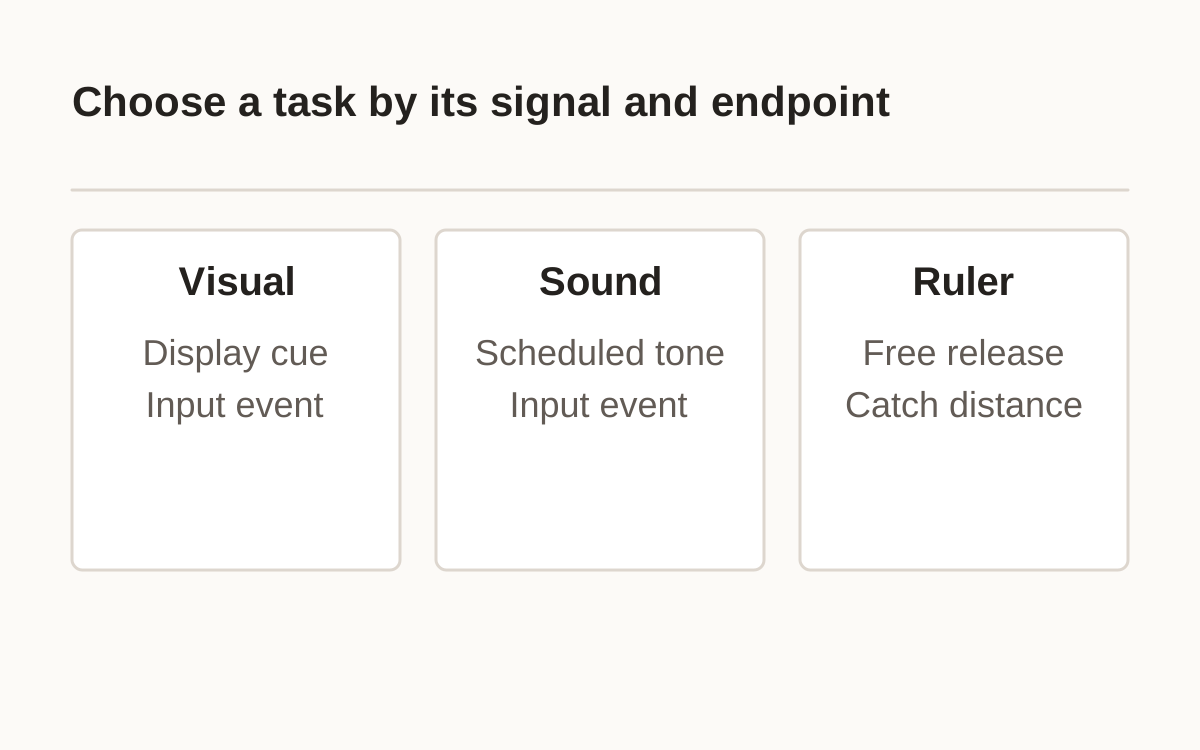
To test reaction time, choose an interval and a method that can observe it. A visual browser procedure uses a cue update and an input event. An auditory task uses its defined software sound timing. A ruler drop uses catch distance to estimate free-fall time. Those methods have different endpoints and equipment.
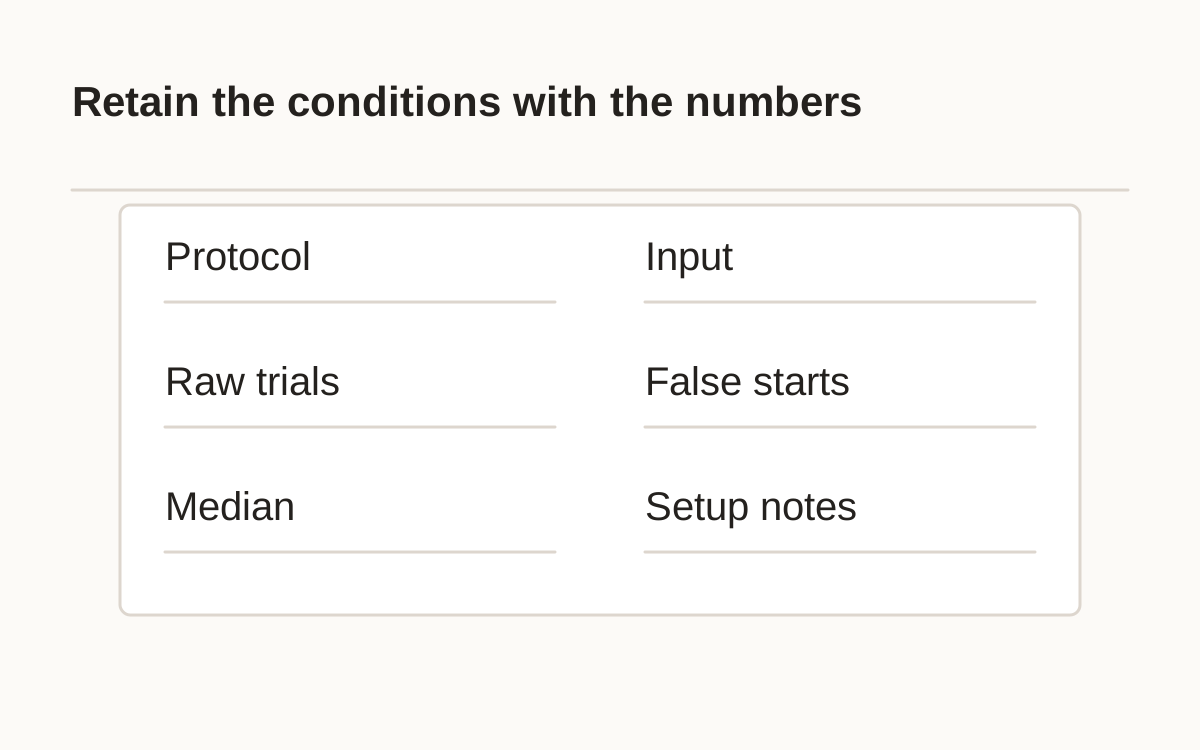
Write the method down first: cue, input, trial count, early-response rule, and summary. Otherwise, a changed procedure can masquerade as a change in the person. Keeping only the fastest trial hides the rest of the series. Retain valid values and the errors or interruptions that explain which trials were completed.
- Choose one method.
- Read its timing and validity rules.
- Keep setup and posture consistent.
- Retain raw trials and errors.
How to test reaction time without mixing invalid attempts?
A repeatable method needs a signal and response endpoint. “Press Space after this visual cue under protocol 1.0” is a narrower, clearer task than “test my reflexes.” Preserve that definition when repeating it.
This documentation defines the monotonic software clock used for intervals; it does not calibrate physical display or input delay. MDN: Performance.now().
How to check reaction time using the same setup?
Here, the simple visual tool completes five valid trials after the cue. Early presses remain separate. The sound tool requires an audible preview and a declared output route. The ruler calculator uses a catch distance and stated free-fall formula; it does not observe release with a sensor.
Choice requires selecting between mapped responses; GO/NO-GO sometimes requires withholding one. They are different tasks rather than interchangeable versions of one measurement. Choose according to your question. A recreational browser session should not determine medical fitness, driving ability, or readiness for a hazardous activity.
| Method | Defined events |
|---|---|
| Visual | Cue update / accepted input |
| Sound | Software audio timing / input |
| Ruler | Release / catch inferred from distance |
| Choice | Cue / correct mapped response |
NASA describes a partner-assisted drop-and-catch activity. Keep its physical procedure distinct from a browser signal task. NASA: Measure Your Reaction Time.
Ways to test reaction time: which task fits your question?
Record device, browser, input, protocol, date, and setup changes. Preserve valid values in their original units and keep early presses, misses, and exclusion reasons. A median summarizes the retained values; range or interquartile range describes spread. A summary without its trial count can hide a very different record.
For a synthetic series of 200, 220, 240, 260, and 280 ms, the mean and median are both 240 ms. This arithmetic is not a benchmark or a visitor dataset. Keep later raw values too; comparing isolated summaries can conceal changed input, task, or errors.
What should a repeatable session record contain?
Repeat the same procedure for a personal comparison. Choosing a new input because it gives a smaller number does not establish an improvement in the person. Display and device changes can alter the path being measured. A log can reveal changed conditions without isolating their physical effect.
For a formal study, choose an appropriate method and read its original documentation, participant procedures, and equipment requirements. This site’s original games make narrower recreational measurements. The lab-report guide’s blank log helps organize observations but does not validate the method or turn a synthetic example into real collected data.
Frequently asked questions
Can I start with one attempt?
One attempt can show the interface, but a labeled series gives more context for comparison.
Should I combine sound and visual results?
Keep the different signal paths in separate comparison groups.
Do I need an account?
These browser tools run without an account.
What should happen after an early response?
Apply the stated protocol and keep the early-response count outside valid latencies.
What if browser storage is blocked?
The tests still run; export the current session locally if you want a copy.
Sources and method
- MDN: Performance.now() · checked 2026-10-21. Read within its original procedure; this site’s examples and rules are separate.
- NASA: Measure Your Reaction Time · checked 2026-10-21. Read within its original procedure; this site’s examples and rules are separate.
Published October 21, 2026 · human-reactiontimetest.com · Report a correction